
Showing posts with label Bible. Show all posts
Showing posts with label Bible. Show all posts
Monday, January 7, 2019
Homily for Sunday, January 6 - Epiphany
Readings for Sunday, January 6 / Epiphany of the Lord: Isaiah 60:1-6 | Psalm 72 | Ephesians 3:2-3, 5-6 | Matthew 2:1-12

Tuesday, October 2, 2018
Presentation: Angels and the Spiritual Life
Faith Formation presentation at St. Ann Catholic Church in Morganza, LA on October 1, 2018.
Tuesday, July 3, 2018

Sunday, February 25, 2018
Lent: Learning to Trust - Homily for February 25
 |
| Abraham and Isaac, c.1617 - Anthony van Dyck |
Today we reflect on the faith of Abraham and the role of the Transfiguration in the faith of Peter, James, and John.
Monday, August 28, 2017
Holy Mass: The Readings - Homily for August 27
 Readings for Sunday, August 27 / 21st Sunday of Ordinary Time: Isaiah 22:19-23 | Psalm 138 | Romans 11:33-36 | Matthew 16:13-20
Each week we hear the readings proclaimed and it can be easy to zone out or be distracted by many other things going on in our minds. The readings, however, are not to be missed because they are the voice of God speaking to us. When we pray we long to hear a response - in the Scriptures we find it. Let us pray for open hearts and open ears, that when the Lord speaks we can hear and respond.
Monday, May 22, 2017
Easter: If you love Me... - Homily for May 21
 Readings for Sunday, May 21 / 6th Sunday of Easter: Acts 8:5-8, 14-17 | Psalm 66 | 1 Peter 3:15-18 | John 14:15-21
The Lord tells us today, "If you love Me, you will keep My Commandments." The keeping of the Commandments of God is, then, not so much a matter of checking boxes off as it is a measure of our love for the Lord Himself. Lord Jesus, we love You. Help us to love You more!
Sunday, May 7, 2017
Easter: United to the Shepherd - Homily for May 7
 Readings for Sunday, May 7 / 4th Sunday of Easter: Acts 2:14, 36-41 | Psalm 23 | 1 Peter 2:20-25 | John 10:1-10
The Good Shepherd calls us to follow after Him, but it is not enough simply to follow behind Him. We must be united to Him. The Church provides many paths to this union, but three hold particular importance: the Eucharist, the Scriptures, and daily prayer. Draw close to Him and He will draw close to you.
Monday, January 30, 2017
Building Blocks: Sacred Tradition - Homily for January 29
 Readings for Sunday, January 29/ 4th Sunday of Ordinary Time: Zephaniah 2:3; 3:12-13 | Psalm 146 | 1 Corinthians 1:26-31 | Matthew 5:1-12
"Where is that in the Bible?" Have you ever heard that question before? Often it comes in response to a teaching of the Catholic faith when speaking with a brother or sister who isn't Catholic, but is from a Protestant denomination. They raise that question of things of the faith, "Where is that in the Bible?" The implicit belief or statement of what they are saying is that unless it's in the Bible, we shouldn't believe it. And yet, that's not exactly what we understand as Catholics. If fact, nowhere in the scripture does it say that only in this book are the things that are the teachings of God. Nowhere in the Bible does it say, "This is the only place where we find the teaching of the truth." Rather we find something that's quite the opposite. In St. Paul's letter to Timothy, he explicitly speaks of the Church as the defender and pillar of truth; not the scriptures, but the Church herself, the Body of Christ, the Living Membership of the Lord. It's thus that we, the Body of Christ, rely not exclusively on the scriptures, but with the scriptures as well as tradition - the living tradition passed down to us from Christ Jesus, to the apostles, to their disciples and down to our present day. It's that that we lean upon, and it's in that that we rejoice.
If you remember, in the early Church there wasn't exactly a Bible that was passed out to all the Christian communities to say that this is the fullness of belief of the things that we are to teach, the things that we are to believe. Rather, they had the oral tradition. The disciples would go and pass on the things that were taught to them. The apostles, hearing all of the things that came from the lips of our Lord, seeing the things He had done, the ways in which He had prayed - they went forth and began to spread that in the Christian community. Only later did they write it down. It was mainly by the gift of the spoken word, the living tradition.
How many times has it been said by new parents, "If only kids came with a manual, things would be a little bit easier." How many times has that desire been there in the midst of a screaming baby at night, you're trying to find some way to console the child, or in the same way teenagers as they are becoming young adults, trying to understand young people, even in the course later in life as children become adults - how do we respond to them as parents. All of these questions would be welcomed to have a manual that answered every single one of them, and yet we know that that's not always the case. Certainly, there are many books about babies, we can know the many do's and don'ts of raising children. But quite often what happens when a person is struggling with how to respond to something that is happening with their children, to a friend or someone else, rather than go to a book, they go to someone with the experience. We go to our own parents and say, "What do I do? How would I respond? How did you respond?" And more often than not, things that are not always written in books are given to us as advice, and often times they work. Not just a written tradition passed down, but a living one. Something that is given from generation to generation and is passed on, and is true. It's much the same with things of Christ in the Church. Of how indeed we do have the scriptures. There are the holy scriptures - the Word of God written for us to help us walk in the path of heaven. Remember too, that we have the living tradition, the family of God.
In the Gospel of John, toward the conclusion, it said that if he wrote down all of the things the Lord Jesus said and did, there would not be enough books in all the world to contain them. So there is this recognition, necessarily so, the gift of faith that we live is not confined to books, but rather is a living gift, the gift of faith passed from one person to the next. Much in the same as Jesus; He didn't pass out papers saying, "Everybody read this paper and reflect on it." Rather He said, "Blessed are the poor in spirit... Blessed are those who thirst for righteousness... Blessed are the peacemakers..." Remember, too, the many accounts that our Lord Jesus would speak in parables and all of these various stories, but then He would go back with His disciples, His inner circle, they would ask more questions and He would give more answers. He would clarify things that often times were a little bit unclear, and we don't have every single one of those clarifications in the scripture, but we do have them passed down from one person to the next, generation to generation to generation. The living gift of our faith.
As Catholics, we understand, believe and profess that there is nothing that the Catholic Church teaches that is contrary to the scriptures. Nothing. But there are things we believe that are not explicitly contained in the scriptures. We can dig a little and see implications there, but it doesn't have to be explicitly stated because we know they have been given to us from Christ; they are a part of our family story.
On the March for Life the other day, on Friday, I was struck by a particular group of individuals who came out to protest. They didn't come to protest abortion. They didn't come to protest the protesters of the abortion. They came to protest the Catholic Church because they know that the Catholic Church is one of the most prominent voices in the right to life movement. And indeed, as we looked around, as we were marching ourselves, some 450 or so students and young adults from the Diocese of Baton Rouge, most of the signs around us were so-and-so Catholic Church or college. It was a very Catholic experience. As we were praying the rosary, we would look around and groups we didn't know would be praying with us. As we were singing the chaplet of Divine Mercy, so too there were many others around us that were praying along with us. It was intriguing because in the midst of that, there was one particular group who came to protest the Church. They had microphones to be able to yell at us over our prayers, and they had signs to let us know that the Pope is the anti-Christ, that all Catholics are going to hell, and we need to repent and believe in the Gospel. I was trying to listen to the individual who was preaching at us as we walked passed. One of the things he said caught my ear. He said, "Brothers and sisters, in 1952 the pope proclaimed Mary assumed into heaven. In 1952, the pope said Mary never died, and we know that St. Paul says the wages of sin is death, and no one is free from death. Therefore the Catholic Church is wrong, and all of you who are Catholic need to understand, repent and turn from the Church." I was marching at that point next to a brother priest, smiled and said to him, "Apparently he never read the document the pope wrote." Because firstly, the pope never said that Mary never died. He is just forcing that reading into it. The pope was very clear; he never said Mary didn't die. But also, there is this implicit belief that because we stated and clarified something in 1952, it doesn't mean that it wasn't true and it doesn't meant that the Church didn't believe it for the previous 1,952 years.
It's a simple reality that never has it been claimed by any Christian Church, by any Catholic community, that they have the tomb of the Blessed Mother. Have you ever thought about that? We can go and point to all the tombs of the apostles. We can point to all the tombs of the saints. We can say they were here and here and here, we know where the Blessed Mother's house is in Ephesus, we can point to all kinds of things, but not one single soul has ever said in the history of the Church or the history of the world, that they have the tomb of the Blessed Mother, and they know where it is. From the first days of the Church, we believe and understood that Mary was assumed into heaven, body and soul. It took us 1,900 years to come to a full explanation and to be able to say definitively because, and only then, it came under attack. If you remember in the early Church the letters of St. Paul - when he was writing, he didn't come to give a catechism lesson. He didn't say, "Let me lay out the entirety of the Christian belief of our faith for you." Rather he said, "I notice in your community, you are struggling with this. Let me respond to that." None of the letters were meant to be a catechism lesson; they were responding to the needs of a particular church in their struggle. So too, it continues down to our day. A question of the Assumption of the Blessed Mother, ultimately led to the pope going, "I see that in our current day there has been a question, a struggle. Let me clarify. Here is what we believe and here's why." Is it in sacred scripture? No. Is it contrary to it? No. Is it something we believe from the beginning? Yes. And we can go down that with so many things that our Catholic Church teaches. Several of them revolve around Our Lady: the Immaculate Conception, her perpetual virginity and those sorts of things. But also they look to the things of the Eucharist, the sacraments of the Church, the life of faith, the life of prayer. Not always included in the scriptures explicitly, not contrary to them, but very much a part of our faith because we have believed it from the beginning.
For 2,000 years, generation upon generation, has received the gift of faith, and every generation's duty is to receive it in its fullness and to pass it on to the next generation in its fullness. To fall short is a grave error on our part. So we receive and pass on. Those family remedies, those tales of things that seem odd and yet they work. Wonderful gifts of our faith.
Often times, whenever we speak of tradition, it is seem as a bad thing. We cling to our human traditions, often times it is said. Us Catholics. And because we cling to our human traditions, we are at fault. But there is a different between human traditions and Sacred Tradition itself. Human traditions can change, and indeed they should, according to the need and the culture of the day. The fact that there is certain days where we fast or feast according to the liturgical calendar, the fact of the liturgical calendar itself, the manner in which we celebrate the sacred liturgy. Sometimes we get the new translation of the liturgy or a new part is added or something is taken away or changed. The fact there are so many other things through the course of the life of the Church, indeed those are human traditions, and as they come and go according to God's will, God be praised. If they served their purpose and they are done, fine, we move on. But Sacred Tradition itself, is non-negotiable. These are not things that come and go according to times and season, but rather are perennial teachings of the Church, from the start, form the hearts of our leaders, the hearts of the faithful.
Something good, true and holy. Not to be set aside, but rather to be cherished because they come forth from the lips of Christ our God. And so we rejoice in this gift. We rejoice in the fact that for 2,000 years, we have had a continuous heritage and history, a family story connected to Jesus Christ. Not confined to a sacred word or text, but rather a part of a true family, one that knows the story and shares its story. So let's pray for the gift of the Holy Spirit, brothers and sisters, to pray that the Holy Spirit would help us to receive the gift of our faith, to receive it in its fullness, and to go forth from this place each and every weekend to share the gift of faith with others, that so too the next generation may rejoice in this gift that we share and pass it on there next.
Monday, January 23, 2017
Building Blocks: Where did the Bible come from? - Homily for January 22
Readings for Sunday, January 22: Isaiah 8:23-9:3 | Psalm 27 | 1 Corinthians 1:10-13, 17 | Matthew 4:12-23
I'm heading out to the March for Life in Washington, D.C. in a few minutes, so this week is only the audio for the homily. Please pray for safety for all those attending the March and for the growth of a culture of life in our world. Our prayers will be with you too.
Monday, December 19, 2016
Advent: With Us, With Him - Homily for December 18
 Readings for Sunday, December 18 / 4th Sunday of Advent: Isaiah 7:10-14 | Psalm 24 | Romans 1:1-7 | Matthew 1:18-24
As we begin this fourth Sunday of Advent. this fourth week, this last full week of the Advent season, as we look forward to the day of the coming of the Lord, we continue our reflection on reconciliation. The second Sunday of Advent I spoke on the way in which Christ came among us for the first time, of how the Infant Jesus taking on our flesh began that process of reconciling all of creation with the Lord God, and drawing humanity to Himself by His way of taking on our flesh, but also to join all of creation with us in the same. Last weekend we reflected on the way in which in Christ, creation was waiting for it's reconciliation in completion. And indeed we wait for the last day of the Lord Jesus, the day in which He will come in His glory. in which reconciliation will be completed and fully accomplished. This weekend, I want to reflect on the way in which we come to be with the Lord and prepare ourselves for that last day. Indeed, the entire time, from the day on which Christmas took flesh until the day He comes again in glory, it has one single purpose. We fill it with so many things, but it has one actual purpose: It's to give us an opportunity to encounter Jesus Christ. It's what St. Peter tells us in His letter as well. He says the Lord delays, so that many might come to know Christ Jesus and be saved. So the Lord, waits, for us, to come to know and love Him. Again, we fill it with a lot of things. Necessarily so in the sense, we get caught up with the things of this life; we get caught up with our homes, work, with the things of the world around us. We get caught up doing good and homily things - spending time with our family and our friends. In the Church, we also lose sight of things sometimes, and we get consumed with other things than what is the central reality of things we ought to focus on. So often we simplify our Catholic faith into a system of "do this, don't do that," rules and regulations. The reality is, our life is more than rules and regulations; our faith is more than rules and regulations. It's not about busying ourselves with many things, but about concerning ourselves with one thing just like St. Mary Magdalene - to know Jesus, to encounter Christ.
In the end, when the Lord comes in His glory on the last day and we are all judged, or if He doesn't come before our death, at the hour of our death, we will stand before the judge, and our salvation for eternal life or eternal death will come basically in conjunction with one simple answer, our own answer. Remember that when Jesus was with His disciples, He was with the twelve after everyone had gone, and He asked them. "Who do people say that I am?". They began to think and respond with the things they had heard, "Some say you are John the Baptist come back again, some say Elijah another one of the great prophets." But then Jesus responds to that question which every single one of us must answer for ourselves, "Who do you say that I am?". Because the answer to that question determines everything, and it manifests to Christ what He already knows, but it manifests to us and to all of creation, something that can often be hidden to us. The answer to the question shows us how much we know God and how much we love Him. That's our entire life. We can have so many things, so many blessings, but if we never know God, we fall short of our purpose; fall short of the reason God created us in the first place.
There are many ways in which we come to encounter God, to encounter Christ. In our own church, there are a whole variety of symbols and signs that speak to us of God. We can look to the Paschal candle near the Baptismal font, the Paschal candle which is light and consecrate on the Easter Vigil, and a hymn is sung to it, a hymn to Christ. We sing to the candle as Christ - the light come into the world to cast out darkness. The crucifix in the sanctuary that speaks to us of the love of God reminds us of what Christ did for us. In the celebration of the liturgy, the priest acts in the person of Christ. When the priests says, "This is my body ... this is my blood," he says it not himself, but as Christ. It's Christ who speaks these things. And you, the members of the faithful of God, members of the body of Christ, to see one another as Christ, to allow Christ who dwells within you to speak to others and to see Him. These and many others are ways in which we can encounter Jesus in this time, but there are two ways I think, and invite you to reflect upon and take some action on this week, two ways in which Christ is primarily with us: in the scriptures and in the Eucharist. They are the two main parts of the Mass: the Liturgy of the Word and the Liturgy of the Eucharist. As it is typically described in liturgical books: the Word and the World made Flesh.
In the first reading today, we hear from the prophet Isaiah and he comes and prophesied a gift from God that a virgin will conceive and bear a son and they will name Him Emanuel, God is with us. We heard the fulfillment of that passage in the Gospel reading as they come and the angel appears to Joseph, and Mary is that one spoken of from of old. Mary, his wife, is the one who is to conceive, though a virgin, and to bear a son - God with Us, Emmanuel. It's the name of Jesus because the name means "God Saves," and God has come to be with us, to save us.
When Jesus was about to ascent to His heavenly Father at the end of His earthly life, one of the things He told His disciples was that, "I will be with you always." He told the disciples, I believe it was at the Last Supper, "I will not leave you orphans." I will not abandon you, I will be with you always. Again, Christ is with us in so many ways, but most especially and concretely in the Scriptures and in the Eucharist.
What I invite each of you to do is to spend some time with the Lord this week in those two ways. Again we know it's the Christmas season, some of you may still have some Christmas shopping left to do, some of you may have some decorating to do, some of us have parties and these types of things going on. But we hear all the time that Jesus is the reason for the season, right? Except it's the thing that seems to happen the least, is the time we spend with Jesus. We get consumed with so many other things. So my invitation for you is to come and rest with the Lord, to come and place yourself in the presence of the Eucharist in the church, and to sit with Christ - to know that He is with you and to be with Him. The church of St. Ann is open all day each day, the church here is open various times throughout the week. The church at St. Mary's in New Roads has the adoration chapel where you can go and adore the Lord face to face in the Blessed Sacrament. Whichever of those options works best for you, I encourage you to take one, and to really speak some time. If the best you can do is five minutes, good, it's enough. If you can do more, good because it is about the encounter with Christ. It is about speaking to the Lord and allowing Him to speak to us. As you would go to the chapel or the church, I would invite you to bring along with you a Bible. The written word of God speaks to us; He comes to us and remains with us.
So often as we go before the Lord, we desire to hear the Lord to speak to us, and we desire to speak to Christ. At least we should. What we see in the Eucharist is not just a thing, it's a person - a person who loves us and desires to speak to us. It's Christ our God, Emmanuel. And so, we speak to Him and we look for Him to speak to us. Where is the way He speaks to us most concretely than in the scriptures? A lot of times we think the scriptures are hard to understand and I think more often than not we over-complicate them, we over think things a little bit it seems. But to be able to pick a place and simply read from the Word of God - start in the Gospels maybe and to hear Jesus speak to you. If you want some other place, go to the letter of St. Paul, St. Peter or St. John; those letters written to other communities like us and to hear them speak. Go to the Psalms - St. Augustine said that the Psalms capture every single human emotion, and to come and allow our hearts to be lifted up to the Lord through a psalm that may speak something that we don't even have the words yet but which Christ does. To go and to speak to Him and to listen - to know Jesus. That's the entire purpose.
On the last day, our judgement will not be a surprise to any of us. If we know Jesus, it shouldn't be a surprise that He knows us. And if we don't know Jesus, it shouldn't be a surprise that He doesn't know us. And so we come. We place ourselves in Him presence. We come to be with Him who is indeed with us. We pray for the grace to love Him more deeply and to seek His face as we go forth from here each day. Come, Lord Jesus. Come O Come, Emmanuel.
*Check out the 10:45 mark of the audio to see what happens when parishioners think there's a fire in the church during the middle of the homily!
Wednesday, August 31, 2016
Papal Intentions for September 2016
 Papal Intentions for September 2016
Universal Intention: That each may contribute to the common good and to the building of a society that places the human person at the center.
Mission Intention: That by participating in the Sacraments and meditating on Scripture, Christians may become more aware of their mission to evangelize.
Mission Intention: That by participating in the Sacraments and meditating on Scripture, Christians may become more aware of their mission to evangelize.
Prayer for the Pope
V. Let us pray for Francis, our Pope.
R. May the Lord preserve him, give him life,
and make him blessed upon the earth,
and deliver him not up to the will of his enemies.
Our Father... Hail Mary...
O God, Shepherd and Ruler of all Thy faithful people, look mercifully upon Thy servant Francis, whom Thou hast chosen as shepherd to preside over Thy Church. Grant him, we beseech Thee, that by his word and example, he may edify those over whom he hath charge, so that together with the flock committed to him, may he attain everlasting life. Through Christ our Lord. Amen.
Sunday, March 23, 2014
How's Your Prayer Life?
 Readings for Sunday, March 23/ Third Sunday of Lent:
Exodus 17:3-7
Psalm 95:1-2, 6-9
Romans 5:1-2, 5-8
John 4:5-42
A couple of weeks ago a friend
sent me a book. I opened it up and started looking through the first few pages
and found a fill-in the blank self-test with questions
such as: Who is the first person you turn to for advice when you’re
having problems with a spouse or significant other? Who is the first person you
turn to for advice when you have tough financial decisions to make? Who is the
first person you turn to when you’re not feeling well? At the conclusion of the
little test there was an answer key of sorts and what it basically said was ‘If
your answer to each of those questions was not ‘Jesus Christ’ then you have
some work to do. Keep reading the book.’
As a priest I often have people
come to me to discuss things that are going on in their life where they are
looking for answers. Things such as those above, as well as major life
decisions, struggles in faith, problems with sin, and a whole host of other
things. And one of the questions that I often ask in response is simply, “How’s
your prayer life?” The normal response is, “Well, it’s pretty good. But,
Father, this what's really bothering me is…” and they revert back to their point. To
which I respond again, “I know. But how is your prayer
life really? What is the Lord doing
in your life right now?” My question about prayer is not just a nice little thing that the priest is supposed to ask. It’s actually at the core of everything.
If we believe Jesus is who He claims to be, if He is the one who created us,
loves us, forgives us, and wants to heal, restore, and sustain us, then our
life must necessarily revolve around Him. And we meet Him in prayer. Prayer is
everything.
The story we just heard from St.
John’s gospel is actually a synopsis of the Christian life of prayer. It starts
with Jesus coming to the well to find rest and then a Samaritan woman comes to
draw water. This simple intro would be raising red flags all over the place of
any Jewish listener. First, the event happening at a well evokes marital imagery,
as every time a well is found in the Old Testament it is in connection with a
man seeking a spouse. Except the Lord comes to wait not for an earthly bride,
but for one to bring with Him to the heavenly marriage feast of Heaven. He’s
looking to save her soul, thirsting for it. And so he says, “Give me a drink.”
The fact that Jesus was there was bad enough, but for Him to speak, that it too
much! Think about it for a second. Who here goes out and cuts their yard at
noon? Nobody. Why? It’s hot! Nobody in their right mind is going to go out to
labor at midday unless there’s some specific reason. And we know her reason –
she was sinner. She was an outcast; someone that the other ladies of the
village wouldn’t have associated with, someone the others would have whispered
about and treated cruelly. So to save herself the trouble, she goes at noon
when nobody else is there because that what she thinks she deserves. She can’t
live a normal life anymore. And there’s Jesus at the well. She thinks, ‘Oh,
well He’s a Jew so it won’t matter.’ But then He speaks and with that she is in
shock. First, she is a woman and he is a man. The two weren’t supposed to
interact in public. Secondly, Jews and Samaritans don’t mingle or even use the
same buckets. And yet He comes and asks for a drink. He tears down every wall
that could be between the two of them, and many of us have more than just two.
We separate ourselves from God because we’re ashamed of our past, we're afraid
of our future, we’re not convinced we can do what He calls us to do today and so we set up walls.
And Jesus comes over and again to tear them down to meet us. Rather than flee,
she decides to stay. There’s something about this Jesus that settles her
despite all of the social rules she’s breaking right in public. She is open to the
encounter of prayer.
What follows is a dialogue that
includes many things we’ve likely experienced personally. The opening point is
that it is a dialogue. All of us are guilty, I’m sure, of giving monologues to
God where we tell Him everything and then politely dismiss ourselves before God
can get a word in edgewise. We’re called to speak and to listen. The first
thing that the woman experiences after deciding to stay in this encounter of
prayer is misunderstanding and confusion. She’s at a well and Jesus is talking
about living water and she wants it but has no clue how He’s gonna get it
because He doesn’t even have a bucket (maybe the heat got to His head?). And
she asks for the living water He gives thinking that she’ll never thirst again
and won’t have to come to the physical well anymore, but she is missing the
whole point. Jesus is speaking and she can’t make sense of it. How many of us
have decided in good faith to pick up the Bible and we do so only to find that
we can’t understand a single thing happening? So we get frustrated because now
we need to go find another book to explain the first book. Or how many times
have we gone to pray about something – we need to know which choice to make in
a tough decision, or we are looking for some guidance, peace or consolation
from God – and we go pray only to realize that nothing is any clearer when we
walk away? Misunderstanding. Confusion. If you’ve ever been in that place, it’s
okay. But don’t let it be the reason you quit prayer. The woman, too, decides to
continue the conversation despite not knowing really what is happening and so
she comes to a new experience. Jesus says to her, “Go get your husband and
bring him back with you.” She quietly replies, “I don’t have a husband.” You
can imagine the knowing-look as he says, ‘I know’ and proceeds to tell her
about her whole life. Here Christ comes to the deepest place of shame and sin
in her heart and wants to address that. And what does she do? What do all of us
do? Change the topic. He comes close to that painful place and she becomes a
great theologian and starts debating Jesus on which religion is the true and
other such things. We too like to change course to some other aspect that’s
easier to discuss, to some theological idea or something we’ve heard before
that we want to reflect on further. But Jesus wants to heal that place where we
need Him most. The woman again perseveres in prayer and the Lord continues to
guide her on the path. Finally, she starts to come down again and speaks of
this messiah that is to come and will tell everything. Here her life changes as
the Lord looks her in the eyes and says, “I Am He.” I Am He. The Messiah, the
one to reveal everything, the one who created you, will save you, and wants to
fill you with peace. I Am He.
We arrive at this most powerful
moment of the whole passage and what happens next? We now interrupt your
program for this commercial break! This scene cuts away to Jesus talking about
reaping the harvest, speaking of the souls to be won for eternal life. Meanwhile
we’re on the edge of our seat waiting to hear the conclusion of things. And we
return to the story to find that the woman has gone to the town, told everyone
about the Messiah and brought a slew of people back with her. They came
trusting in her word and then came to believe on their own because the Lord
stayed two days talking with them. Jesus, the Jesus man, spends two whole days
talking, eating, and praying with these people He isn’t even supposed to go
near.
Brothers and sisters, Jesus is at
the well in this very moment waiting for us to go to Him and to encounter Him
again. There’s absolutely nothing that can keep us from Jesus Christ. It
doesn’t matter where we’ve been, where we are right now, or where we’re going
in the future - He’s already there waiting for us. Waiting to have the chance
to ask us for a drink, to ask us to give Him our whole life to Him for
eternity.

All of us start Lent with our
penances and we have great aspirations of what is going to happen and hopes to
have a good Lent. I doubt that I’m the only one who has given myself a free
pass from time to time on these things. When Fr. Ed brought home a bunch of
sweet the other day I reasoned myself into it. I mean, after all, it really was
an act of charity since he had two whole cakes that I eat part of both of them
so He wouldn’t have to have it go to waste. And a couple of the cookies too.
And the brownies. And the fudge… So there I stood licking my fingers of the
last few crumbs, frustrated that Lent wasn’t going as well as I had hoped. If
you’re in a similar place, the good news is that we’re not even halfway through
the season. We still have four full weeks before Easter comes and that is more
than enough time for God to do incredible things in our lives.
So, I want to make a challenge to
everyone in the Church today to encounter Jesus in these next four weeks and to
do so in a specific way. Hopefully you all know about the Eucharistic Adoration
Chapel at the Lutcher Chapel. In that chapel 24 hours a day, 7 days a week,
every day of the year except the three days before Easter, the Lord Jesus is
present in the Eucharist, exposed so that you can look upon His Body and Blood
and in a sense speak to Him face to face about whatever is happening in your
life. He is truly waiting for you to go visit. So that’s my challenge: for each
of you here to spend at least 30 minutes in Adoration twice a week for the next
four weeks. That’s only four hours out of a month. But here is a promise I can
make: there is not a single person here today that can go and spend 30 minutes
twice a week in Adoration and really seek the Lord in prayer who would be able
to look me in the eye on Easter Sunday and say that nothing has changed in their
life. If we spend time with Christ in prayer, we’ll be confused sometimes, we’ll
be challenged to repent of sins, we’ll sidestep the Lord here and there, but in
the end we will encounter the God who was waiting for us the whole time. So I
ask you, How’s your prayer life?
 |
| Photo by Jeff Geerling |
Sunday, March 16, 2014
Mass on the Mountain
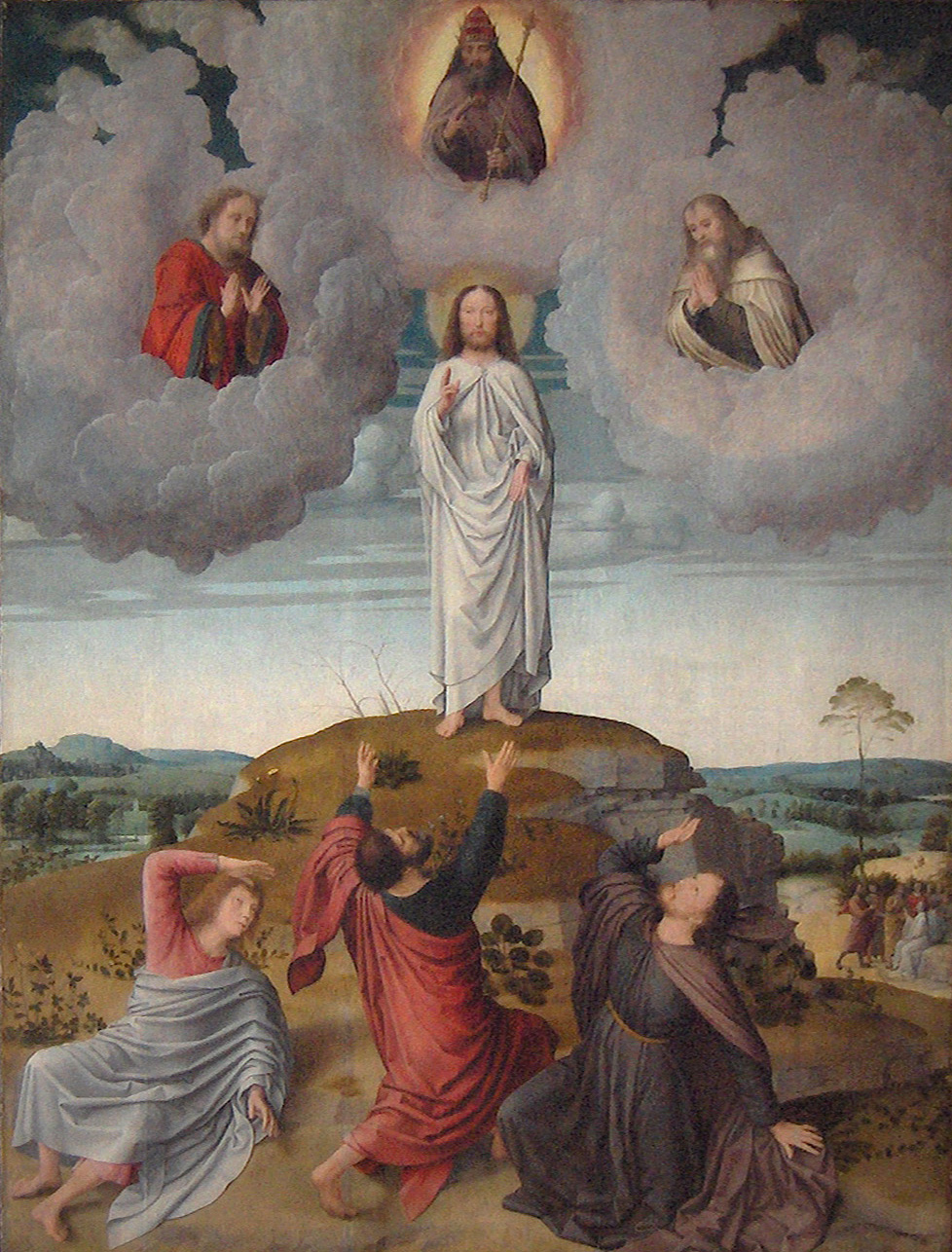 |
| Transfiguration of Christ by Gerard David |
Genesis 12:1-4
Psalm 33:4-5, 18-20, 22
2 Timothy 1:8-10
Matthew 17:1-9
If you’ve heard a handful of my
homilies (or maybe read the blog), you’ll probably know that I love talking
about typology – how God uses events that point toward something greater to
come, a sort of ‘shadow’ that longs for it’s fulfillment. The crossing of the
Red Sea is a type for baptism. The union of Adam and Eve is the type for
marriage. We could name countless instances of such events in the Bible, but as
I was praying with the Scriptures today, I realized that the Gospel passage we
just heard was yet one more of those events that in some way points toward
something greater to come. The Transfiguration, if you’ll stick with me for a
few moments, is actually what we’re experiencing in every celebration of Holy
Mass.
Let take a look. It begins by
telling us that, “Jesus took Peter,
James, and John his brother, and led them up a high mountain by themselves.”
This little intro setting the stage is actually quite important for two
reasons: 1) It is Jesus – God Himself - who brings them to a separate place to
be with Him for a specific event. Likewise, it is God who draws us here today.
We come of our own free will, but it was God who first put that desire or
compulsion in our heart. 2) He calls them to a separate place for a specific
purpose. Almost every time we hear about a mountain in Scripture it is in
relation to some encounter with God Himself; Adam & Eve, Noah, Abraham,
Isaac, Jacob, Moses, the prophets at various points, and this one with Jesus is
yet another. You may not have thought about it before, but almost every
Catholic Church you’ve been to in your life has a step to get up into it
because we are coming to have another encounter with God here in this church.
Stretching the connection a little bit, I laughed while thinking about this
because us Louisiana people don’t have hills much bigger than the levees out
front and I remember the first time I lived in the mountains for a while and
how every time I wanted to get to my cabin up top I had to make several stops
long the way to catch my breath again. And the Bible says it was a high
mountain, so in a sense I guess you could say that the beginning part of the
journey was also the penitential rite! Maybe a stretch, but it works!
Anywho, continuing on. The
passage carries on as Jesus “was
transfigured before them” and they beheld for a moment His radiant glory as
His face and clothes “became white as light.” This incredible event was a
physical way of Jesus revealing Himself and letting the disciples understand a
little more who He really was. And is this not the exact thing that happens in
the reading of the Scriptures? The presence of Moses, the one who gave God’s
law to the Israelites, and the greatest prophet, Elijah, who pointed forward to
Jesus, indicates that the whole law and prophets were awaiting this one man to
come among us. Each weekend we hear those same readings from the law and
prophets in the Old Testament and the letters and Gospels of the New Testament
and are able to hear Jesus speaking to us about who He is. When the disciples
see what is happening Peter cries out, “Lord!
It is good that we are here! Let’s build three tents!” He wants to stay
there because of the joy of the occasion. Shouldn’t we too be rejoicing in the
occasion of revelation from Christ? The truth is that if we come here and are
not impacted in some way by the readings there is a problem because we have
become deaf to the voice of God. It’s a time to be attentive and wait for the
Lord to speak to us and reveal Himself to us in some way. But it is not enough
for us to stay in that place.
In the middle of Peter’s
exclamation to Christ, bright cloud cast a shadow over them and a voice pierced
the skies saying, “This is my beloved
Son, with whom I am well pleased. Listen to Him.” A statement and a
command. After the revelation of Christ in the Scriptures we celebrate the
Eucharist and a sort of shadow comes over us, too, veiling the full mystery at
hand – there is chalice veil, incense, and various prayers and actions and in
the midst of them all the sacred statement: “This is My Body. This is the
chalice of My Blood.” followed by the command: “Do this in memory of Me.” The
disciples prostrated themselves on the floor, but we simply kneel in humble
adoration as the Heavens are opened up to us as well and we receive what Jesus
describes as the Bread from Heaven, His own flesh.

Here comes the part that is most
profound. The disciples are there, faces pressed to the floor in reverential
fear of the Lord. And we are told that “Jesus
came and touched them, saying, ‘Rise, and do not be afraid.’” Holy
Communion is the time when Jesus comes to us. He descends from the heavens onto
this holy altar and then He descends the steps to come to each of us and
touches us; flesh touches flesh. And He says to each of us “Rise, and do not be
afraid.” All of us have our cross to bear. That’s what St. Paul is reminding
St. Timothy of in our second reading when he says, “Bear your share of hardship for the gospel.” He’s basically saying,
‘Timothy, pick up your cross! Walk!’ This walk is not something we can do alone
otherwise end up like this third Station right here when Jesus falls the first
time, except it happens a thousand more. We have to rely upon Him and the grace
He gives to us. St. Paul continued his urging, saying, “He saved us and called
us to a holy life, not according to our works but according to his own design
and the grace bestowed on us in Christ Jesus.” The calling God gives us and the
grace He pours out are not because of anything we have done but wholly because
we are part of His plan. Each of us has a purpose and all of us are written
into a certain part of God’s plan. Our daily task is to seek it out and to
fulfill it. And this is the conclusion of the Gospel.
When Jesus tells them to ‘Rise,
and do not be afraid’ it says that “when the disciples raised their eyes, they
saw no one but Jesus alone.” They saw no one but Jesus alone. This could be taken in two ways. First,
it is important for us to have Jesus Christ truly as the center of our life. It
is for us to see Jesus alone because we are always looking to Him so that no
matter whether we are at work, school, church, ball practice, the grocery
store, or playing games, Jesus is the center and everything else revolves
around Him. Jesus isn’t a part of our life. He is the whole foundation of
everything else. Secondly, it can be taken to indicate that every person that
they encountered from then on, they saw Jesus in that person. The poor person
in need of help: Jesus. Those ignorant of the faith: Jesus. The person that
aggravates us to no end: Jesus. The person that talks bad about us: Jesus. The
random person that we don’t know their name: Jesus.
My brothers and sisters, we’ve
climbed the mountain today to encounter the Living God. We have heard His
revelation to us. We will soon kneel in adoration at that sacred statement and
command, and then we will be touched by God and given strength to walk forward.
The task then is for us go out and seek to love, serve, and honor those in need.
God grant that we might walk away changed today and truly see Jesus alone.
Monday, January 6, 2014
Time Wasted Well
 Readings for Sunday, January 5/ Epiphany Sunday:
Isaiah 60:1-6
Psalm 72:1-2,7-8,10-13
Ephesians 3:2-3,5-6
Matthew 2:1-12
The other night Fr. Vincent (the pastor) and
I were talking about the feast of the Epiphany and the readings this weekend
and between us we came up with around two dozen different homily ideas about
the gifts, the Magi, Herod, and a whole list of aspects, but what has been
resonating most in my heart was the star, on account of an article I read about
Dr. Frederick Larson, who managed to take a computer program and chart out what
the sky would have looked like 2000 years ago right around the time Jesus would
have been born. What he found was interesting and I’d like to take a few
moments to share it.
He
noticed, looking from the east of Jerusalem where the Magi would have been,
Jupiter, the brightest planet in the sky, moved back and forth in the sky in an
elliptical motion that like a crown. This crown was directly above a star known
as ‘Regulus’ or ‘King’. A king was being crowned. Interesting.
That
‘crowning of a king’ took place within the constellation ‘Leo’ or ‘The Lion’
and, as we heard in the scriptures tonight, the Messiah, was predicted to come
from the tribe of Judah, which was illustrated as a Lion. This was widely known
in Jewish culture, but the surrounding peoples also knew it since Jerusalem was
a major city between Africa, Europe, and Asia where other cultures would
interact with the Jewish people. So now there’s a king being crowned and it is
taking place in Leo. Fascinating… but there’s more.
As
we know from our astrological signs these days, the sign that follows Leo is
Virgo, the Virgin. But this wasn’t just the ordinary appearance of Virgo. This
time, at the feet of the Virgo constellation was a crescent moon, knowing in
the culture of the day as the ‘birthing moon.’ So in addition to the ‘King’
being crowned in the Leo constellation we now have a birth in connection to a
Virgin. All of these things make perfect sense to us, but at the time they were
having to put all of this together to try to grasp the meaning. When they did,
the immediately hopped on their camels and rode toward Jerusalem to greet the
new king. This is where we picked up in the Gospel today, with the Magi going
before King Herod inquiring where the newborn king was so they could do him
homage. When they finally learn that the child was to be born in Bethlehem they
prepare to head out.

Going
back to Dr. Larson’s work, though, we also find something very interesting
taking place. Fast-forwarding some months we see that Jupiter is not longer
crowning Regulus but is now intersecting with the planet Venus, so the
brightness of the two planets was then magnified to form an even brighter light
in the sky which the Magi would never have seen before! And because the star
was moving in the sky and they were moving as well in geographical location,
the bright star seemed to stop in the sky. And from the perspective in
Jerusalem, guess where it stopped directly above – Bethlehem. Just like it said
in the Gospel.
That
seems absolutely incredible to me to think that all of those things were used
so that the Magi would find Christ. God made the stars and planets, set them in
motion, arranged for all of those things to happen as they did so that the Magi
would be able to read the signs of the times and encounter God in the flesh. It
shows the extreme love that God has for the Magi, and the reality is that He
has the same love for each and every one of us. Who knows what great lengths
God has gone to in making it possible for each of us to come to know Him in our
lives today, to have encountered Him when we did for the first time and to
continue that encounter daily.
To
aid us in benefitting from the encounter and sometimes being able to have it in
the first place, there are three things that the Magi can teach us to do
better: waste time well, study, and follow.
I
can waste time on anything under the sun. I have no shortage of things fighting
for my attention, but the thing is to waste time well. Think about how much time we spent with our family and
friends in recent weeks celebrating the holidays. Countless dinners, parties,
visits, and simple gatherings where we just sat with loved ones and talked or
watched Christmas movies and football games together. How much of that was
really ‘productive time’ in the sense we normally think of it? When we’re
enjoying a good gumbo with friends are we really able to say we’ve checked
things off of our ‘to do’ list? No. It’s wasted time in a sense, unproductive
time. And yet it was incredibly valuable time wasted because we strengthened
our relationships or built new ones. And just the same with our relationship
with the Lord. Many saints and holy people have spoken of prayer as time
‘wasted’ with God. It’s not productive. We’re not getting a list of things
completed, but we are growing in faith, hope, and love. The Magi wasted a ton
of time simply star-gazing, watching how things love around at night. For
months and years they simply stared into the heavens. It wasn’t all for
nothing, though. It led them to God. Are we willing to set aside time in order
to simply waste it on the Lord? Are we willing to encounter Him?
The
second thing the Magi can teach us is to study. They had to spend many hours
grasping the movements of the heavenly bodies, surely much recourse to mapping
the skies was had, and they had to have a working knowledge of these many things
going on all at once so they could make sense of the signs they saw. Are we
willing to study for the Lord? If they hadn’t studied the skies, they would
have done exactly what Herod did and what most of us do: look up at the sky,
remark about how pretty it is, look for a bit and then move on. They would have
missed the signs that led them to God. There are so many things these days that
can help us to grow in our faith and to understand the ways that God is
speaking to us throughout our days and how to respond better. There are books
and magazines, tv stations, online videos, blogs, and news sources galore to
learn about our faith and to learn about the things of the world that can
permit us to draw closer to God. We can stay at the surface level or we can
commit to even just a small bit of reading and really deeper our understanding,
love and appreciation for our faith in God and God Himself. The choice is ours.
Are we willing to study and find God more easily?
 The
last thing is following. It’s hard to follow because that means we give up
control. I know that in a very real way as a priest. You know that priests make
several promises at their ordination to the priesthood and diaconate
ordinations. At diaconate I made the promise of permanent celibate chastity and
the commitment to praying the Liturgy of the Hours, the official prayer of the
Church recited throughout the day. At priesthood I made the promise to imitate
the mysteries that I celebrated and daily conform my life to Christ. All of
those things I promised once. Guess what you have to promise twice – obedience!
You have to make the promise at diaconate and again at priesthood ordination.
It’s tough to follow when we want to lead. The Magi saw the signs in the sky
and they simply left to follow after it. They didn’t know what they would find
or how things would pan out in the end. They followed the invitation of God.
Are we willing to do the same? Often the Lord invites us to things – to a
particular act of charity towards another, to service in the Church or
community, to a deepening of prayer and a call to set aside something to grow
in holiness. Are we willing to follow or do we seek to excuse ourselves. There’s
always an excuse, always a reason why I shouldn’t so this or that which the
Lord may be inviting me to. But there is one reason why I should do it: Jesus
Christ wants it. Are we willing to follow Christ or have we chosen our own way?
The
last thing is following. It’s hard to follow because that means we give up
control. I know that in a very real way as a priest. You know that priests make
several promises at their ordination to the priesthood and diaconate
ordinations. At diaconate I made the promise of permanent celibate chastity and
the commitment to praying the Liturgy of the Hours, the official prayer of the
Church recited throughout the day. At priesthood I made the promise to imitate
the mysteries that I celebrated and daily conform my life to Christ. All of
those things I promised once. Guess what you have to promise twice – obedience!
You have to make the promise at diaconate and again at priesthood ordination.
It’s tough to follow when we want to lead. The Magi saw the signs in the sky
and they simply left to follow after it. They didn’t know what they would find
or how things would pan out in the end. They followed the invitation of God.
Are we willing to do the same? Often the Lord invites us to things – to a
particular act of charity towards another, to service in the Church or
community, to a deepening of prayer and a call to set aside something to grow
in holiness. Are we willing to follow or do we seek to excuse ourselves. There’s
always an excuse, always a reason why I shouldn’t so this or that which the
Lord may be inviting me to. But there is one reason why I should do it: Jesus
Christ wants it. Are we willing to follow Christ or have we chosen our own way?
May
God grant us the wisdom to see the many ways He speaks to us, that we may
rejoice in those gifts and seeks to increase their number by our openness to
waste time well, to study, and to follow always the Light that is Christ Jesus.
Amen.
Wednesday, December 11, 2013
HWP: Saint Damasus
Today is the feast of St. Damasus, Pope from the 4th Century and a man of profound impact upon our faith, though he is seldom mentioned. St. Damasus had a great devotion to the saints of the Church, specifically the martyrs, and he made it a major part of his mission to ensure that their remains were well cared for, thus preserving their tombs and relics for us to continue to venerate some 1600+ years later. He also encouraged St. Jerome in his continued translation of the Scriptures into what is known as the Latin Vulgate, the official edition used by the Church for nearly a millennium and a half. Humble servant of God he was, he continues to serve as such before the Throne of God in Heaven. So let us pray...
A Prayer to Saint Damasus
Saint Damasus, instead of worrying about the short term of life on earth, you took God's view and looked to the things that last. Pray for me that I may be able to look beyond immediate popularity and fleeting favors, and choose to do the things that God wants me to do. Amen
Sunday, October 20, 2013
They're ALIVE!!!
 Readings for Sunday, October 20/ 29th Sunday in Ordinary Time:
Exodus 17:8-13
Psalm 121:1-8
2 Timothy 3:14-14:2
Luke 18:1-8
I don’t know about y’all but I
love the Old Testament, especially because every so often it will have one of
these gems of a story that we hear this evening, where Joshua and the people of
Israel fight against Amalek and his army and th outcome is determined not by
might or strategy but by whether Moses hands were up… or down. Yep! So the
story goes! The reality is that when God first began to reveal Himself to the
people of Israel they were in need of many physical signs and manifestations of
His presence and guidance. God used that foundation to speak later of the
deeper meaning of the physical signs that would lead His people to a more
spiritual approach to life in the Lord. In the end it wasn’t really the
placement of Moses’ hands that was all that important so much as the meaning of
his hands being raised up in the first place. To have your hands lifted up in
the air was a sign of prayer before God. We see it today in the liturgy when
the priest extends his hands in prayer at various times throughout the Mass,
especially in the Eucharistic Prayer, as well as in many more charismatic
communities. Also, consider that Aaron and Hur were on either side holding up
his hands and we can easily conceive that Moses was actually holding his arms
out, foreshadowing Christ crucified who would win us the ultimate victory. The
point of the story is to remind us that to the extent that we are people of
prayer and conform ourselves to Christ crucified we will be victorious in our
battles. And to the extent that we are not people of prayer and flee from
imitating Christ crucified we will experience defeat.
This emphasis on prayer is what
St. Luke drives home as a preface to Jesus’ story, as he writes of “the
necessity for them to pray always without becoming weary.” It wasn’t that it
was highly advisable that the disciples prayer, or that they should do so when
they get a free moment and don’t have anything better to do. It is an absolute
necessity to pray and to persist in prayer. Our God desires to pour out His
blessings on us but we must do our part in seeking them out. We must be people
of prayer.
The story from Exodus isn’t just
a story of a battle that took place some 3000+ years ago. It’s story of every
single one of us gathered here in this church today. That people once bound in
slavery had received the promise of a land flowing with milk and honey,
symbolically of place of life, prosperity and joy. To arrive at that place,
however, they had to battle many nations who sought to keep the Israelites from
entering the land. Our story is the same except that rather than freedom from
physical slavery we fight to be freed from the bonds of slavery to sin. And the
battles that we are called to fight, St. Paul tells us in Ephesians 6:12, are
not against flesh and blood but against principalities and powers. We are
fighting against our sinful flesh, against the world that tempts us, and
against the devil who always seeks to deprive us of peace. And the land that we
long to attain is not an earthly place but our heavenly homeland where all the
angels and saints await us. It is for us to be willing to hold up our hands and
gain the victory.
On this topic of prayer, Blessed
John Paul II said this in a 1979 address to youth: “We must…pray because we are
frail and guilty. It must be humbly and realistically recognized that we are
poor creatures, confused in ideas, tempted by evil, frail and weak, in
continual need of inner strength and consolation. Prayer gives the strength for
great ideas, to maintain faith, charity, purity, and generosity. Prayer gives
the courage to turn from indifference and guilt if unfortunately we have
yielded to temptation and weakness. Prayer gives light to see and consider the
events of one’s own life and of history in the salvific perspective of God and
eternity. Therefore, do not stop praying! Let not a day pass without having
prayed a little! Prayer is a duty, but it is also a great joy, because it is a
dialogue with God through Jesus Christ! Every Sunday, Holy Mass: if it is
possible for you sometimes during the week. Every day, morning and evening
prayers, and at the most suitable moments!”
These words of this soon-to-be
saint recall that need for us to come weekly for Mass but also to come before
the Lord daily in prayer. The great thing about our Catholic faith is that we
have so many diverse ways to pray and there are enough rote prayers written by
saints and sinners throughout the centuries that you could write them all on
sheets and paper and they’d stack up clear from the floor to the roof of the
church and probably higher. But the bad things is that we have so many diverse
ways to pray and different prayers we could pray that it easily becomes a
problem because we don’t know where to start!

While there are many great ways
to pray, there is one privileged place to start with our prayer and that is
Sacred Scripture. Our second reading called to mind the fact that “All
scripture is inspired by God and is useful for teaching, for refutation, for
correction, and for training in righteousness.” The key word in there is
‘inspired’ because that means that God breathed His Spirit into the text. It’s
not just words like every other book in the world, but is a book that is alive
and speaks to us if we are willing to take the time to listen. And one way that
the Church has offered pray with the Scriptures throughout the centuries is
what is known as Lectio Divina, or divine reading. Some of you may have heard
of it and some of you may be doing it already without realizing it.
The method of Lectio Divina is
simple and composed of four basic steps. First is to read. Pick a selection
from the Bible and read through it a couple of times. Usually a word or phrase
will stick out if we’re attentive. The second step is meditating on the text.
Ask questions about why things are the way they are, what details might be
pointing to, what does this have to do with the bigger picture. And spend some
time putting yourself into the shoes of the people in the story – consider what
it might be like to be the Apostles hearing Jesus teach, or a Pharisee
receiving a sharp rebuke, or the Blessed Mother watching your son in His
ministry. As we really begin to interact with the text and place ourselves in
the scene, the Lord will usually begin to raise questions in our own hearts that
are in need of answering. That leads us to the third step of prayer. We take
the things we’ve reflected upon and the things the Lord ahs brought up and we
bring them to Him in prayer and ask how we can be changed and transformed by
what we’ve read. And lastly we sit in contemplation, which is simply to rest in
God’s presence not necessarily doing anything for ourselves but letting God
give the grace we need to put into action the things we’ve prayed about.
 You can do that with any Bible,
but sometimes the text isn’t so clear. To help with that I recommend a book
entitled ‘The Better Part: A Christ-Centered Resource for Personal Prayer” by
Fr. John Bartunek (HERE on Amazon; it's also available for iPhone). It is a tool that is worth its weight in gold, and I don’t
say that lightly. This book has the power to change and transform our lives by
transforming our prayer and I speak from personal experience as I’ve been using
it for the past year myself. The first 60 pages or so are a primer on prayer
that addresses all of our questions on prayer such as ‘How do I pray?’, ‘What
is prayer supposed to be like?’, ‘Am I praying well?’ and ‘I feel stuck in my
prayer, how can I get better?’ These and other questions he addresses in a
straightforward fashion. Then the next 950 pages or so are used to break open
the Gospels. He takes the four Gospel and splices them into sections like we
have at Mass and for each section for the entirety of the Gospels he has three
separate reflections that help to draw us deeper into the mystery of the Scriptures
and to encounter Christ. If we make the time to pray, especially with this
book, we will indeed be found possessing that faith the Lord longs to find upon
His return. So let us today as God’s grace to keep us strong in our faith, that
we might indeed be always lifting up our hands to the Lord in prayer.
You can do that with any Bible,
but sometimes the text isn’t so clear. To help with that I recommend a book
entitled ‘The Better Part: A Christ-Centered Resource for Personal Prayer” by
Fr. John Bartunek (HERE on Amazon; it's also available for iPhone). It is a tool that is worth its weight in gold, and I don’t
say that lightly. This book has the power to change and transform our lives by
transforming our prayer and I speak from personal experience as I’ve been using
it for the past year myself. The first 60 pages or so are a primer on prayer
that addresses all of our questions on prayer such as ‘How do I pray?’, ‘What
is prayer supposed to be like?’, ‘Am I praying well?’ and ‘I feel stuck in my
prayer, how can I get better?’ These and other questions he addresses in a
straightforward fashion. Then the next 950 pages or so are used to break open
the Gospels. He takes the four Gospel and splices them into sections like we
have at Mass and for each section for the entirety of the Gospels he has three
separate reflections that help to draw us deeper into the mystery of the Scriptures
and to encounter Christ. If we make the time to pray, especially with this
book, we will indeed be found possessing that faith the Lord longs to find upon
His return. So let us today as God’s grace to keep us strong in our faith, that
we might indeed be always lifting up our hands to the Lord in prayer.Sunday, August 11, 2013
Eyes On Heaven
 |
| 'St. Philomena' by Mic Carlson |
Psalm 33:1, 12, 18-22
Hebrews 11:1-2, 8-19
Luke 12:32-48
Today, August 11, is the feast of
St. Philomena, a virgin martyr from the third century. Second only to our
Blessed Mother, she is my ‘go to gal’ for intercession with Our Lord Jesus, so
it was with great joy that when I arrived in our community I was greeted by two
images of St. Philomena at St. Michael’s in Convent and the story of the chapel
of St. Philomena that once stood in Grand Point. Indeed she loves our community
very much, so let us pray for her intercession especially in this sacred time.
Something that I have come to do
in my personal prayers before images of Our Lord, Our Lady, and the angels and
saints, is to situate myself before them in such a way that they are looking at
me. To be able to look them in the eye and feel as if they are looking back at
me helps me to remember that the image I’m praying before is representative of
a person truly alive in Heaven. They’re real, they’re praying for us, and
they’re hoping that we’ll one day enter into their joy. So it always does my
heart good to be able to look upon them face to face. But one thing I’ve
noticed with most of the images of St. Philomena is that she won’t look at me.
I have a statue and framed image of her but as often as I’ve prayed before them
I find she will not look at me, but instead looks through me. Those images in a
very powerful way show the reality that she was not caught up in earthly things
but set her eyes on heavenly things, on the world to come, on eternity.
This is what Our Lord invites us
to do today, to store up treasure for ourselves in heaven, looking past all the
temptations to store it up instead here on earth. St. Philomena was a young
girl beautiful to behold. There was something in her that shined upon all whom
she met – her name even means ‘daughter of light’. A Greek princess of royal
blood on both parents’ sides, she had much in her favor for a life of riches.
When she went with her parents to Rome she was noticed by the Emperor, who
desired to take her as his wife. She declined, stating that she had consecrated
her virginity to Christ and she was His alone – this all at thirteen years of
age! In anger, the Emperor had her imprisoned, hoping to break her spirit. It
did not work. She was scourged just like our Lord, but was miraculously healed
the next day. Arrows were shot at her but to no avail. Even flaming arrows were
shot, but they turned back and killed the archers themselves. An anchor was
tied around her neck and she was to be tossed into the Tiber River in Rome, but
as they tossed her in she anchor was mysteriously came away and she was found
on the shore perfectly dry, said to have been brought there by angels. Finally
she was struck with a sword and received the martyr’s palm. She could have had
the whole world at her disposal and lived a life of luxury most of us can
hardly even conceive of living. And yet her eyes were not here, but looking
toward heaven. Her treasure and her heart were firmly placed within the
heavenly gates.
This past week I went on a short
retreat for a few days and enjoyed the gift that time, being able to sit in the
silence and experience God in a powerful way in my prayers both alone and in
the community where I was staying. I was on that spiritual high that often
accompanies a retreat. And when I came home, I found as I always do that I
hadn’t really changed that much. I still had to battle with the same sins,
still had the same temptations to avoid this or that task, to exercise my vices
rather than virtues. In short, I realized that my heart is not completely in
heaven yet. I still try often to store up treasure here on earth for myself.
And I don’t think I’m alone in that. I think most of us are in the same boat on
that point – we all have at least one sin that we fight against, that one
possession we cling to, that one thing, whatever it may be, that keeps us from
really letting our hearts go up to heaven. We keep those little treasures here
for ourselves just in case – just in case Christ doesn’t fulfill us, just in
case we’re not happy like we want, just in case.
How do we get away from this? How
can we work to set our eyes and our hearts on heaven? It’s quite simple – not
easy, but simple. We need only look at four main areas in our lives. Back in
Lent we had books free for the taking, one of which was Matthew Kelly’s book
The Four Signs of a Dynamic Catholic (available HERE for only the cost of shipping). In that book he outlines those four ways
which I remember by a nice little acronym – PEGS. Prayer, Evangelization, Generosity, Study. PEGS.
 Prayer. Are we praying? I mean
REALLY praying? Not just mindlessly saying words from a pray card or book, but
speaking those or other words from our very heart. We have to pray regularly,
telling God what is going on in our mind and heart, what is happening in our
life, where we need His help, where we’ve seen His work, and how we experience
and return His love. If we don’t know Christ personally and dialogue with Him
we are far from heavenly joy. And at Mass, are we really praying there? I’ll be
the first to admit that I struggle to pray every time I’m at Mass. It’s easy to
just say the words without really meaning it, but we’re called to enter deeply
into this celebration. Prayer.
Prayer. Are we praying? I mean
REALLY praying? Not just mindlessly saying words from a pray card or book, but
speaking those or other words from our very heart. We have to pray regularly,
telling God what is going on in our mind and heart, what is happening in our
life, where we need His help, where we’ve seen His work, and how we experience
and return His love. If we don’t know Christ personally and dialogue with Him
we are far from heavenly joy. And at Mass, are we really praying there? I’ll be
the first to admit that I struggle to pray every time I’m at Mass. It’s easy to
just say the words without really meaning it, but we’re called to enter deeply
into this celebration. Prayer.
Evangelization. We have to share
the Good News! When I get on Facebook I see all the updates – people in new
relationships, getting married, having babies, experiencing this or that
activity – good things that they want to share. None of us ever experiences
something that is incredible and fails to tell a soul about it. No, what do we
do? We share it with everyone around us because we want them to know about it
to. And if there is anything we should be excited about it is the salvation we
have in Christ Jesus. When we truly encounter Christ in prayer – and only after
that – we will be changed and want to tell others, to seek them out and say
‘let me tell you what Christ did in my life today, let me tell you what
incredible things He has done.’ Evangelization.
Generosity. As I look out I see
many faces who help in various ways and ministries in our community. It is a
joy to see that. We must be generous with our gifts. Yes, we need to tithe, but
we need even more to be people of service. People who are filled with the
Gospel call to charity and seek to build up the Church and the Kingdom of God
with our gifts, not keeping them for ourselves but sharing them generously. Generosity.
Study. We must grow in our
knowledge of the faith. We have to read and know the Scriptures. We have to
know our theology, our catechism lessons, the stories of our saints. It’s easy
to study, we do it in so many other things. We know all the celebrity gossip,
we know about our favorite TV shows, video games, internet sites, car parts,
clothing stores, and the list goes on. We study the things of the world, but
how willing are we to study the things of God? To spend a few minutes with the
Bible everyday? To pick up a good book or cd on something of the faith and
immerse ourselves in it? To set our hearts in heaven , this is an absolute
must. St. Jerome once said that ignorance of Scripture is ignorance of Christ
Himself. And the same coule be said of His teachings given through the Church. If
we don’t know our faith, we don’t know our God. Study.
PEGS. Prayer. Evangelization.
Generosity. Study. If we want to go to Heaven, the path is a tough one but the
method is simple. If we start with these four areas and try to live them each
day and grow in them throughout our lives, we can be sure that there will be
much heavenly treasure built up for us. And if we refuse to live these four
things and grow in them throughout our lives, we can be sure of the opposite.
The choice is ours and ours alone. Let us choose wisely and follow the path
that St. Philomena has walked before us. Let us choose Christ.
Subscribe to:
Posts (Atom)