
Showing posts with label Typology. Show all posts
Showing posts with label Typology. Show all posts
Monday, March 11, 2019
Come to the Desert - Homily for March 10
Readings for March 10 / 1st Sunday of Lent: Deuteronomy 26:4-10 | Psalm 91 | Romans 10:8-13 | Luke 4:1-13
The Lord was led to the desert for a reason. We're invited there for a reason too.

Sunday, August 16, 2015
The Blood (John 6 - Part 4)
 |
| Spreading Blood on the Doorposts |
Proverbs 9:1-6
Psalm 34
Ephesians 5:15-20
John 6:51-58
Have y’all noticed how many of my
homilies begin with ‘when I was in seminary’? It was a very formative time!
Anywho…
When I was in seminary J we had an interesting
outing one day as we drew near to our ordination as priests. We went to one of
the funeral homes in New Orleans and they showed us the rooms where they
prepared bodies and also the crematory where they would do the cremations. It
was really fascinating to see the ‘behind the scene’ view but what intrigued me
most was that as we were going around they showed us one special room and told
us that it was specifically for the Jewish community because they had certain
ways that they would wash and care for the body of the individual, particularly
in the preservation of the blood, as opposed to it simply being consumed as
would that of other individuals. I didn’t expect it but it made perfect sense
because, for the Jewish people, the blood is of great importance. Do you
remember the scene from Mel Gibson’s The Passion of the Christ when the Lord
had just been scourged? Recall how Our Lady went out with a cloth and began to
soak up all the blood on the ground and to clean the area. It’s because of the
importance of blood.
Blood is of such importance that
we go all the way into the 4th chapter of Genesis before we hear
about it for the first time. Here it is the blood of Abel that cries out from
the ground after Cain had slain him. Interesting that it’s not the flesh, not
the body; it’s the blood. The second time ‘blood’ is spoken of is in the
following verse when Cain is told that he has Abel’s blood on his hands. And
the third time comes in chapter 9 of Genesis in the story of Noah. As Noah
proceed from the Ark after the flood, the Lord says to him: “Every moving thing
that lives shall be food for you; and as I gave you the green plants, I give
you everything. Only you shall not eat flesh with its life, that is, its
blood.” You shall not eat flesh with its life, that is, its blood. Blood is
life.
The prohibition of eating flesh
with blood meat obviously that there were not rare steaks in the Old Testament
and this ultimately comes down to the reality that to consume the blood of a
creature was to have it’s life in you and thus to be joined with it.
We see the use of blood all
throughout the Old Testament in the lives and worship of the Jewish people. The
sacrifices of bulls, goats, birds, and the like were all vicarious sacrifices.
They were essentially saying that on account of my sins I deserve to die, but
this animal is able to die in my place, to pay its life rather than mine. We
see this in the use of blood over the doorways at Passover to save people from
death and to guarantee life. This idea was brought in as well in the worship in
the tabernacle and later in the Temple. At different times that altar, horns of
the altar, the people, and the sanctuary were sprinkled with blood, as sign of
being cleansed from sin by the life of an animal being poured out. Too, we can
see that the Mercy Seat – the dwelling place of God in the Holy of Holies – was
sprinkled each year on the Day of Atonement. First-hand accounts from the time
of Jesus recount how on the days in preparation for Passover nearly 250,000
lambs were slain to fulfill the command of God to eat of the lamb. So much
blood was shed that they say the priests in the sanctuary waded through it up
almost to their knees and they had drains in the floor for it to pour out and
flow down the mountainside – a river of blood pouring from the side of the
Temple and joined at the bottom to a river of fresh water, the blood and water
flowing side by side as they merged. You can see the imagery tied to the even
of the Cross.
So we can see that blood
ultimately comes to have four emphases: it saved or protected people as in the
Passover, it washes away sin and guilt by the vicarious gift of the animal, it
joined the person to the creature if the blood was consumed, and the
consumption of the blood gave the life of that creature to the one partaking of
the blood.
All of this is the background
that colored Jewish life each day and all throughout the year. They always had
to look at their meats to discern ‘does it have any blood in it?’ Always the
search for blood. And now we get into the Gospel.
Last week we left of with, and
this week we begin with, the Lord telling the people “The bread that I will
give is my flesh for the life of the world.” This strange saying confuses his
hearers and they all begin to wonder to themselves and to speak aloud their
confusion: “How can this man give us his flesh to eat?” Jesus, recognizing
their confusion, responds and tell them that it was all symbolic, that it was
just an analogy, that He didn’t mean it literally. Right? No. What’s
interesting is that Jesus knows the confusion in the hearts and minds of the
crowd before Him and has the opportunity to tell everyone that the bread He was
talking about was just a spiritual reality, a symbolic joining of ourselves to
Himself, an analogy of faith. But He does the exact opposite – He intensifies
His words.
 |
| Precious Blood of the Child Jesus |
“Amen, amen, I say to you,” the
double amen emphasizing that what follows was of great importance, “unless you
eat the flesh of the Son of Man and drink
his blood, you do not have life within you. Whoever eats my flesh and
drinks my blood has eternal life, and I will raise him on the last day. For my
flesh is true food, and my blood is true drink. Whoever eats my flesh and
drinks my blood remains in me and I in him. Just as the living Father sent me and
I have life because of the Father, so also the one who feeds on me will have life
because of me.”
Drink His Blood!? Four times in a
row He says to drink His Blood?! I’d imagine one of two scenarios happened at
this point: either you could have heard a pin drop with the shocked silence of
the crowd or a great uproar of blasphemy charges would have been hurled at the
Lord. Either way the reasoning is the same. God, from the days of Noah,
prohibited the consumption of blood in the animals and yet here this Jesus, the
so-called Son of God, is saying that they were not only to drink His blood but
indeed they must in order to have life! Does He realize what He’s saying? The
blood has power to wash away sin and guilt, to preserve those on whom it rests
from the angel of death and to bring life, it joins one to the creatures whose
blood was shed and gives the life of that creature to the one who consumed it!
And that is exactly the point.
It is right not to consume the
blood of an animal that would lower one’s dignity, but with the entrance into
history of the God-Man Jesus Christ, the consumption of His Blood does not
lower us but raises us up to a higher state. It gives us eternal life, where
once only temporal life was attainable. It saves us from sin and joins us to
Christ – He remains in us and we in Him. It’s all in the power of the Blood of
Jesus and it is that same blood, that true drink, which we have the joy of
being able to receive each time we come to Mass.
So I conclude this week with the
question for reflection: How do we reverence the Eucharist?
If the Lord’s Body and Blood are
true food and true drink which we receive here, how do we show that? What about
our spirit, body and thoughts here at Mass shows our reverence and love for the
Eucharist? What in our lives outside of these walls continues to speak to us
and to others and He is here? How do we reverence this gift of His life-giving
Blood?
Sunday, August 9, 2015
The Journey (John 6 - Part 3)
 Readings for Sunday, August 9/ 19th Sunday in Ordinary Time:
1 Kings 19:4-8
Psalm 34
Ephesians 4:30-5:2
John 6:41-51
Earlier this weekend I had the
joy of going to New Orleans to celebrate the wedding of two friends of mine at
the seminary where I spent four years preparing for the joy that is priestly
life and service. In the short day that I was there, I was immediately faced
with one of the parts I liked least about New Orleans: the potholes. The only
time I wasn’t bouncing around, it seemed, was when I was stopped. The constant
sway and thump of the car as I went along kept me conscious that I was moving
somewhere. I began to think about the many ways that other means of transportation
give us similar experiences. Turbulence on planes, swaying on trains, and the
movement of boats that if endured long enough makes you feel like you’re still
on it well after you’re sitting at home on the couch. The point is that all of
those things provide a sensible awareness of movement. One of the great
tragedies of our day is the truth that while we are on a journey, moving toward
our final end, it easily happens that we are completely unaware of that
movement. For instance, are you conscious of the fact that right now we’re
moving at a high velocity as the Earth orbits the Sun? In the same way, the
spiritual life is one in which we are called to be aware of our movement or
bear serious consequences otherwise.
Last week we continued the
reflections on John 6 as we discuss the necessity of food. This week we pick up
with food once more, as the Scripture shows us that the food is necessary for a
purpose, for a journey. Once again the Church gives us a back story in the
first reading to help frame the teachings of Jesus in the Gospel, and this week
it is Elijah the prophet. What is interesting to me is that the reading we just
heard, when joined to the passages immediately before and after it, is much the
same as the story of the Israelites’ and their journey we heard the last two
weeks.
Immediately prior to the passage
we heard was the story of Elijah and the 400 prophets of Baal. The Israelites
had begun to turn away from God and worship false gods, of which Baal was one
of the more notable. Elijah challenged the 400 prophets to a test: to set two
altars up on the mountain and see whose god would show up. The 400 prophets of
Baal did their chants, dances, and invocations and nothing happened. Elijah
poured water on his altar, invoked the God of Israel, and the whole things was
consumed by fire from heaven. Having shown that the God of Israel was Lord, he
took the 400 prophets and had them killed, symbolically turning away from false
gods and toward the Lord. It was a story of conversion of the people, much like
that of the Israelites’ being set free from slavery in Egypt. And just as the
freedom from slavery led the Israelites into the desert, so too Elijah fled to
the desert. That’s where we pick up the story today. He goes a days journey and
lies down. He is awoken to eat and drink, which he does. Then it happens again,
with the angel adding to it a deep insight for him and for us both: he must eat
in order to have strength for the journey. The food was the necessary starting
point for the journey that Elijah would make 40 days through the desert and the
40 days wasn’t just happenstance. The Israelites wandered 40 years, Elijah 40
days, Jesus was in the desert 40 days, Lent for us is 40 days. I think you get
the gist. The story is simply replayed anew. And so the forty days journey
leads Elijah to Mount Horeb, and this is where the story ends today. But we
know the rest of the story without having to even have it read because we know
what happens when we climb a mountain, right? We encounter God. And the same
with Elijah. He climbs Horeb and there sees great fire, a powerful earthquake
but then came a still quiet whisper and he knew it was the Lord passing by and
he covered his face and bowed down in prayer. The Israelites travelled 40 years
to go up (think mountain!) to the Promised Land. Elijah went 40 days to the
mountain to meet God. And us? We’re on a journey too and it’s a journey not
just to a land provided by God or an encounter with God that lasts only for a moment.
We are on a journey to the heart of the Father through that of the Son by the
grace of the Holy Spirit that we culminate in us being part of their embrace
for all eternity in the reality that call ‘Heaven’.
As I said at the beginning, the
problem so often is that we forget we’re on a journey at all but rather think
that this is the main portion of our lives and we spend our time not looking
anywhere else but being caught up in the things of this world, the stuff of our
daily lives. And when we forget that we’re on a journey, we don’t worry about
stocking up on the food.

Put more practically: why do we
have to come to Mass? You’ve surely heard the question from someone else, maybe
even thought it or said it yourself. I know I have. “Father, I don’t understand
why I have to go to Mass. I can pray anywhere since God’s everywhere.” Gardens
and farm fields, deer stands and duck blinds, prayer spots and little chapels
in a home. All of these are places we can pray and should pray. Our life should
be a continuous conversation with God that finds us in all sorts of places
offering prayer. But my question in the midst of all of them is this: where’s
the food? We have to have food for the journey to heaven and Jesus makes it
clear that He’s coming to provide it. Where’s the food?
Coming to Mass is about
glorifying God first and foremost for everything He’s done for us and for
everything He is in Himself. He deserves it simply for that. But why do we
come? What makes Mass different than any other experience of prayer, regardless
of the space? The Eucharist. Here and here alone are we nourished with the
Bread of Life that opens for us the gates of Heaven. It’s for us to respond to
the promptings of the angels that surround us and actually partake of it, to
rise once more and be strengthened for the journey.
In conclusion I have one basic
question: how often do we contemplate Heaven? Heaven is eternal and if we
though about it, this life is but the first letter of a single book in an
entirely library full in comparison to eternity. How are we setting out minds
on the place that awaits us? How are we storing up treasure that never fades?
How often to do we contemplate Heaven?
Sunday, August 2, 2015
The Food (John 6 - Part 2)
 |
| Good, but not the Bread of Heaven |
Exodus 16:2-4, 12-15
Psalm 78
Ephesians 4:17, 20-24
John 6:24-35
We continue this week with the
second installment of the five-week reading of John 6. If you remember, last
week we heard the back-story with the feeding of the 5000 with five loaves and
two fish. It was prefaced by the story of a similar miracle worked at the words
of the prophet Elisha, but the difference between the two was the ‘something
new’ that Christ was working and we found it in that key phrase of St. John:
The Jewish feast of Passover was near. We saw how the feast sets the stage for
what is to follow, namely a call to partake of a special food, embark on a
journey, witness the shedding of blood, and make a decision that has life and
death consequences. And so we pick up today in the place where Louisianans
almost always start: food.
Our body needs food. When we
don’t get it or don’t get enough of it, our body lets us know. When I was in
college and had just come back to the Church I was zealous in my desire to do
great things for the Lord and so when Lent came around I resolved to embark
upon an intense fast from food. One day I was sitting in my Latin class working
on an exam and my stomach began the ‘hungry gurgle’ and proceed to make this
loud, awkward sound for a solid minute. Not exaggerating. My classmates looked
at me with the obvious question in their eyes “What is going on with this guy?”
I was hungry and my stomach let me, and everyone around me, know it.
The key, I said, to the whole
story is the event of Passover. In our first reading we get a glimpse of life
after the Passover. The Israelites ate the lamb and special foods as prescribed
by the Lord and they survived just as they had been promised. And now they set
out from Egypt, passed through the Red Sea and have begun to wander in the
desert on the way to the Promised Land. But the problem is the hungry gurgle.
Their stomachs begin to rumble and then their mouths begin to grumble to one
another. Pretty soon the whole people is ready to return to slavery simply in
order to have their bellies full once more!
The Lord hears the cry of His
people, as He always does, and commits Himself to providing for them bread in
the morning and flesh in the evening. Evening comes that first day and upon the
camp descends a flock of quail enough to feed everyone. This is miraculous in
itself because there were over 600,000 men, not counting women and children in
this great exodus of the Israelites. That’s A LOT of quail! And then in the
morning they wake up and walk outside of their tents and ask ‘Manna?’ The word
‘Manna’ literally means ‘what is it’ and so this stuff scattered far and wide
was not something they were familiar with at all, even having travelled the
desert for a while. Moses comes to them to explain that it is the Bread of
Heaven, as promised by God Himself.
This Bread of Heaven was also
miraculous. It was such that those who could only gather a little and those who
gathered a lot were both perfectly supplied, none were left wanting. It was
required that the Manna be gathered only enough for that day. In some cases the
people tried to increase the amount gathered to last them two days so they
could take a break and not work; the manna spoiled overnight every time except
on one specific night: that of Sabbath. Only on Friday were they Israelites
able to gather a double portion and have it keep for the next day without
souring and this was at the Lord’s command so that they could keep holy the
Sabbath and not be consumed with work. What’s more, this miraculous bread
appeared every day for 40 years while the people were on the journey to the
Promised Land and it stopped on the exact day that they cross over into it and
not a soul has seen the Manna fall since that day. The Bread of Heaven
nourished them all along the journey and was among the most powerful reminders
of the power and providence of God for His people.

This is the back-story this week
for the words of Jesus. Keep in mind the 5000 had just been fed and Jesus went
off with the disciples to another place. In the passage we just heard the crowd
has tracked Him down and His response gets us into the really meat of His
teaching on the Eucharist. The people gather around Him and He tells that they
are seeking Him not because they saw signs – not because they had encountered
God or experienced His power – but because their stomachs were full and it’s
time to eat once more. He points out that they were driven by a less noble
reason, much like their ancient ancestors who were tempted to return to slavery
just to get food once more. Recognizing that they have come with empty stomachs
He tells them to strive for the food that endures to eternal life. Jesus
obviously knows because nobody is going to tell you to strive for something and
shrug their shoulders when you ask them about where to find it. Jesus is
drawing them into the dialogue to pull from them the desire to attain this food
that endures to eternal life. And so they ask. They recall how their ancestors
ate Manna in the desert and boldly look at Jesus and question Him: “What can
you do?”
“It was not Moses who gave you the bread of Heaven; my Father gives you
the true bread of Heaven. The bread of God is that which comes down from Heaven
and gives life to the whole world.”
With this Jesus powerfully drives
home the point that it was not Moses, but His Father who provided the bread.
But even more powerfully He states that it was not the TRUE bread of Heaven. It
was simply a foreshadowing, a symbol of the reality that the Father would
eventually send not just to feed ONE nation but to feed ALL the nations. And
what is this true bread of Heaven? What is this ultimate reality that the
Father sent to give life to the whole world? Where can one partake of this true
Bread?
“I AM the Bread of Life.”
‘Jesus Himself is the Bread of
Life? How can this be? How are we to eat of Him and receive eternal life?’ the
Jews immediately questioned in their hearts. We already know the teaching that
is come and yet with what joy we pause to contemplate the wonder of such a
claim!
The readings both challenge us
this weekend with one basic question: why are we here? Why do we come to Mass?
Do we come to come to encounter the Living God once more or is it that we get
some spiritual feeling out it? Maybe we just like the music or the sermon or the
community? What draws us here?
Today is the feast of St. Peter
Julian Eymard, a priest of the 1800’s who had a fiery love for the Lord Jesus
in the Eucharist. I wanted to end here with a quote from the last sermon he
ever preached:
We believe in the love of God for us. To believe in love is everything. It is not enough to believe in the truth. We must believe in love, and love is Our Lord in the Blessed Sacrament. That is the faith that makes Our Lord loved. Ask for this pure and simple faith in the Eucharist. Men will teach you; but only Jesus will give you the grace to believe in Him. Come and receive Communion in order to have the strength of faith, not merely the satisfaction, the feeling of faith. You have the Eucharist, what more do you want?
Sunday, July 26, 2015
The Key (John 6 - Part 1)
 Readings from Sunday, July 26/ 17th Sunday in Ordinary Time:
2 Kings 4:42-44
Psalm 145
Ephesians 4:1-6
John 6:1-15
This week we begin the five-week
reading of the Bread of Life Discourse in John 6, which is one of the most
beautiful and important in the whole of Scripture. The Old and New Testaments
are full of all sorts of powerful stories, inspiring messages, and encouraging
quotes, but it seems to me that John 6 ranks even ahead of them for the simple
fact that it is Jesus Christ Himself talking about the Eucharist. The
Eucharist, as Vatican II’s Sacrosanctum Concilium tells us, is the source and
summit of the Christian life; it is the starting place of our life and it’s the
end goal toward which we perpetually move. The Eucharist is everything because
it is Jesus Himself. And what a joy it is to have these five weeks to pause and
reflect on that blessed gift.
The whole section begins with a
reading from 2 Kings to help set the stage because we begin at a disadvantage
being 2000 years after the events. The Jewish people of the day were a verbal
culture that told their story over and over again in great detail to recount
the many ways that God had worked in their midst. They were able to recognize
in daily life the many stories and little details from the Old Testament, much
like we are able to do from time to time with the Gospels, and apply them in
their own day. We Catholics are infamous for not being strong in our Old
Testament studies, so the Church gives us a little foothold to start with in
the person of Elisha the prophet.
Elisha, being the successor of
Elijah the prophet, was a man of great notoriety and did many wondrous works.
Today we hear that there are a hundred hungry people before him and the only
food available is twenty barley loaves, which we’re told would not be enough
for the whole crowd. Knowing the Lord’s desire to work a miracle, Elisha commands
the bread to be passed out anyway and the miracle of the multiplication happens
in the midst of the people, much to their amazement. God has provided for His
people!
It is this miracle that sets the
background for us to commence the reflection on John 6, which begins in much
the same fashion. The Gospel begins with the Lord getting out of the boat once
again and walking ashore with His disciples. Rather than stop on the shore of
the sea, they continue forward and climb the mountain. Here the Jewish people
would likely have paused with great anticipation at what was about to happen
because they knew that anytime you climb up a mountain, it is for one purpose:
to meet God. Adam and Eve begin in Eden, which was a mountain. Abraham climbs a
mountain to encounter His God. Alongside Him is Isaac who also encounters the
Lord. Jacob too. Elijah, the same. And Moses has the most notable of all – he
sees God face to face! So radiant was his face that the people asked him to
wear a veil to cover his face because it hurt their eyes. He encountered God on
that mountain and communed with Him so deeply that He was physically changed.
And so Jesus climbs the mountain with His disciples and the people look on in
stunned silence awaiting the event that was surely about to unfold. And then –
He sits! This, too, might seem an unimportant detail but it has great weight in
Jewish tradition because to sit was a sign of authority that one has over what
is about to be said and done. Interestingly, these two still carry over into our
Catholic faith, though you may never have realized it before. Have you noticed
that nearly every Catholic church you’ve ever stepped foot in has a step or
multiple steps to ascend to the altar? Even in our churches we recognize the
need to ‘climb the mountain’ to meet our God. Often it is three steps,
signifying the encounter with the Triune God – Father, Son, and Holy Spirit.
And the sitting too has a place. In the manner of preaching the Word of God at
Mass, a deacon is permitted to preach from the ambo where the Gospel is
proclaimed. A priest is permitted to preach from the ambo or standing at the
presider’s chair. A bishop, however, is permitted to preach from the ambo,
standing at the presider’s chair, or sitting at the presider’s chair. He as a
successor of the Apostles has the authority to speak sitting, unlike myself.
It’s beautiful to realize how these things bear great significance even in our
rituals today.
Continuing on, we see that Jesus
has climbed the mountain and sat down. Now He raises His eyes to see the throng
of people coming His way and turns to Phillip and asks where they can buy some
food for everyone to eat. At this point I feel really bad for Phillip because
it’s obviously a setup. Phillip, frustrated, responds that 200 days wages of
money wouldn’t even put a dent in the cost to feed the people at their feet.
Here Andrew pipes up with what I personally presume is a joking response of
‘Lord, this boy here has five barley loaves and 2 fish!’ as if that were going
to help anything. Twenty loaves shouldn’t feed a hundred. What are five loaves
to five thousand? And yet the Lord acknowledges it is enough and has everyone
seated on the green grass, spoken of in Psalm 23, ready for the Good Shepherd
to feed them. Note that it is barley loaves once more, just like Elisha had. He
takes those loaves and gives thanks and distributes it to the people and, in
like manner, the fish. Pretty soon all the people gathered have had their fill
and the leftovers fill twelve wicker baskets. The Lord has provided for His
people again, just like with Elisha! But something is different this time
because the people see in the Lord something different and recognize Him as THE
Prophet, not just A prophet. The Lord sees this and quickly wraps up the day,
departing to be alone on the mountain.
The Lord Jesus worked a miracle
that was absolutely incredible to everyone present there that day and to all
who read it even now. But the question we must ask ourselves is this: how is it
different from the miracle of Elisha? Yes, the Lord feeds more people with less
bread, but is that all? I suggest that it is not and I further suggest that the
key to understand the ‘something new’ that Jesus does is found in one little
phrase that St. John includes and yet which doesn’t seem to fit: “The Jewish
feast of Passover was near.” This insertion by John could easily be taken as a
mere time indicator, but it is in fact the key to understanding the rest of
John 6 and much of the theology of the Eucharist that has been taught from the
earliest days of the Church. To assist us in this, let’s travel back in time to
revisit the Passover.

It came about in the time of
Israel’s slavery in Egypt. They had previously gone down in a time of famine
and the people quickly began to prosper. They became a great nation of people
and the Egyptians, fearing their takeover of the country, forced them into
slavery. For several hundred years the people of Israel, the Jews, labored as
slaves to Pharaoh. After a great time the Lord God came and told them it was
time to leave Egypt and take possession of the Promised Land, the land promised
to Abraham long ago and as yet unclaimed. Pharaoh rejects any possibility of
the people leaving and increases the weight of their labors. In response the
Lord sends the 10 Plagues. The water turns to blood and Pharaoh’s magicians do
the same. The locusts come and Pharaoh mimics it as well. Even turning stick to
snakes and other such marvels has no effect on the wicked master of the
Israelites. And so the Lord send the 10th and final plague: the
Angel of Death. On a particular night, the angel would pass over Egypt and kill
the firstborn of every man and beast in the land. And to the Israelites He gave
the directions on how to avoid such a death. He commanded that each family was
to procure a spotless, unblemished lamb with no broken bones and to sacrifice
it. They were to take the blood and sprinkle it on the doorpost of their homes
with a hyssop branch and then roast the lamb, whole and entire. Once cooked,
they were to sit down and eat the lamb as a family, but not in normal fashion.
Instead, they were to be packed for travel and dressed to leave, sandals on
their feet and their walking stick in hand. All the families who did so and
partook of the lamb would be guaranteed to live to the next day and not suffer
the terror of the final plague. And the people did it. That night as the
Israelites slept in their bed, their stomachs full of fresh cooked lamb, the
Angel of Death passed over Egypt killing every firstborn child and beast in the
land. Pharaoh and the Egyptians woke up to a seen of absolute horror and
actually commanded the Israelites to leave. They gave them their jewelry,
clothing, food, and more as a way of pleading for them to get out of their
country and give them some peace. And so the Israelites depart Egypt, pass
through the Red Sea, wander 40 years in the desert, and ultimately find their
way to the Promised Land that is symbolic of heavenly life.
The Passover was the beginning of
that entire process of salvation and joy and, as such, was among the most
important feast of the Jewish people. They were called to celebrate it each
year, each family slaying a lamb and eating it in the same manner as their
ancestors: ready for a journey because they had survived the Angel of Death.
Not only was it important to
them, but it is especially important to us because it is the background for the
words that Jesus will speak in these next four weeks. In the coming Sundays we
will hear about a special food that we must eat, a food that is tied to a
journey, a food that requires the shedding of blood, and one which has life and
death consequences, literally. The Eucharist is not to be taken lightly but
must be solemn reflected upon and honored. Join with me in this serious reflection
upon the source and summit of the Christian life. For a bit of reflection for
the week, I invite you to reflect simply on two questions:
The first is tied to the first
reading. Did you notice that the barley loaves give to Elisha were from the
firstfruits? These were the first part, the best part in a sense. So the
question for us: Do I give God the first fruits of my day/week/life or am I
content to give Him the leftovers or what I feel comfortable with?
Secondly, Do I trust the power of
Jesus? It’s easy to say ‘yes, of course, Father, that’s why we’re here’ but I
invite you to keep reflecting. Imagine you’re Andrew looking at a crowd of 5000
hungry people and we have 5 fives, do you trust Jesus?
Through the intercession of St.
Ann, may these coming weeks see our heart draw even nearer to the Lord Jesus
who humbles Himself to draw near to us.
Sunday, March 16, 2014
Mass on the Mountain
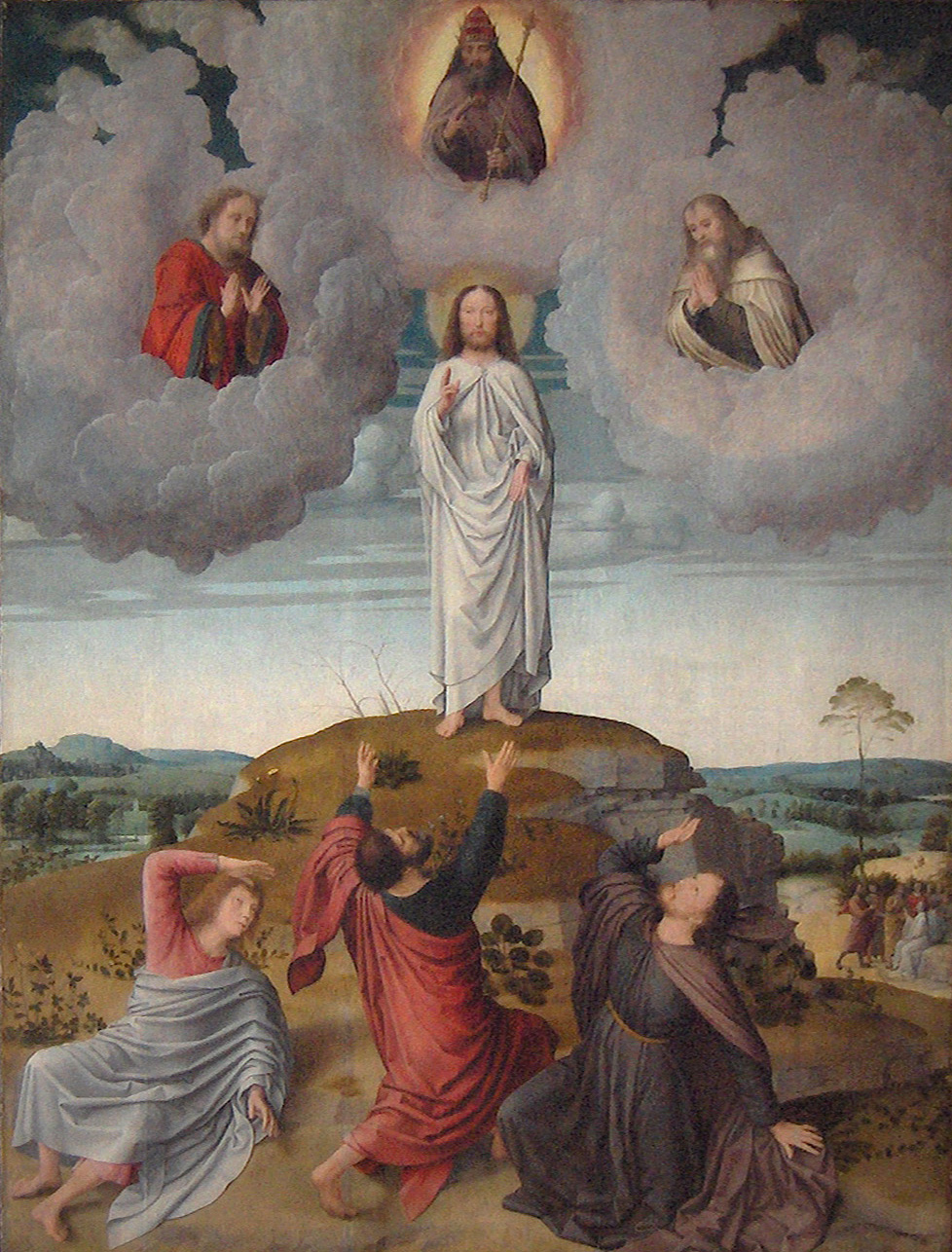 |
| Transfiguration of Christ by Gerard David |
Genesis 12:1-4
Psalm 33:4-5, 18-20, 22
2 Timothy 1:8-10
Matthew 17:1-9
If you’ve heard a handful of my
homilies (or maybe read the blog), you’ll probably know that I love talking
about typology – how God uses events that point toward something greater to
come, a sort of ‘shadow’ that longs for it’s fulfillment. The crossing of the
Red Sea is a type for baptism. The union of Adam and Eve is the type for
marriage. We could name countless instances of such events in the Bible, but as
I was praying with the Scriptures today, I realized that the Gospel passage we
just heard was yet one more of those events that in some way points toward
something greater to come. The Transfiguration, if you’ll stick with me for a
few moments, is actually what we’re experiencing in every celebration of Holy
Mass.
Let take a look. It begins by
telling us that, “Jesus took Peter,
James, and John his brother, and led them up a high mountain by themselves.”
This little intro setting the stage is actually quite important for two
reasons: 1) It is Jesus – God Himself - who brings them to a separate place to
be with Him for a specific event. Likewise, it is God who draws us here today.
We come of our own free will, but it was God who first put that desire or
compulsion in our heart. 2) He calls them to a separate place for a specific
purpose. Almost every time we hear about a mountain in Scripture it is in
relation to some encounter with God Himself; Adam & Eve, Noah, Abraham,
Isaac, Jacob, Moses, the prophets at various points, and this one with Jesus is
yet another. You may not have thought about it before, but almost every
Catholic Church you’ve been to in your life has a step to get up into it
because we are coming to have another encounter with God here in this church.
Stretching the connection a little bit, I laughed while thinking about this
because us Louisiana people don’t have hills much bigger than the levees out
front and I remember the first time I lived in the mountains for a while and
how every time I wanted to get to my cabin up top I had to make several stops
long the way to catch my breath again. And the Bible says it was a high
mountain, so in a sense I guess you could say that the beginning part of the
journey was also the penitential rite! Maybe a stretch, but it works!
Anywho, continuing on. The
passage carries on as Jesus “was
transfigured before them” and they beheld for a moment His radiant glory as
His face and clothes “became white as light.” This incredible event was a
physical way of Jesus revealing Himself and letting the disciples understand a
little more who He really was. And is this not the exact thing that happens in
the reading of the Scriptures? The presence of Moses, the one who gave God’s
law to the Israelites, and the greatest prophet, Elijah, who pointed forward to
Jesus, indicates that the whole law and prophets were awaiting this one man to
come among us. Each weekend we hear those same readings from the law and
prophets in the Old Testament and the letters and Gospels of the New Testament
and are able to hear Jesus speaking to us about who He is. When the disciples
see what is happening Peter cries out, “Lord!
It is good that we are here! Let’s build three tents!” He wants to stay
there because of the joy of the occasion. Shouldn’t we too be rejoicing in the
occasion of revelation from Christ? The truth is that if we come here and are
not impacted in some way by the readings there is a problem because we have
become deaf to the voice of God. It’s a time to be attentive and wait for the
Lord to speak to us and reveal Himself to us in some way. But it is not enough
for us to stay in that place.
In the middle of Peter’s
exclamation to Christ, bright cloud cast a shadow over them and a voice pierced
the skies saying, “This is my beloved
Son, with whom I am well pleased. Listen to Him.” A statement and a
command. After the revelation of Christ in the Scriptures we celebrate the
Eucharist and a sort of shadow comes over us, too, veiling the full mystery at
hand – there is chalice veil, incense, and various prayers and actions and in
the midst of them all the sacred statement: “This is My Body. This is the
chalice of My Blood.” followed by the command: “Do this in memory of Me.” The
disciples prostrated themselves on the floor, but we simply kneel in humble
adoration as the Heavens are opened up to us as well and we receive what Jesus
describes as the Bread from Heaven, His own flesh.

Here comes the part that is most
profound. The disciples are there, faces pressed to the floor in reverential
fear of the Lord. And we are told that “Jesus
came and touched them, saying, ‘Rise, and do not be afraid.’” Holy
Communion is the time when Jesus comes to us. He descends from the heavens onto
this holy altar and then He descends the steps to come to each of us and
touches us; flesh touches flesh. And He says to each of us “Rise, and do not be
afraid.” All of us have our cross to bear. That’s what St. Paul is reminding
St. Timothy of in our second reading when he says, “Bear your share of hardship for the gospel.” He’s basically saying,
‘Timothy, pick up your cross! Walk!’ This walk is not something we can do alone
otherwise end up like this third Station right here when Jesus falls the first
time, except it happens a thousand more. We have to rely upon Him and the grace
He gives to us. St. Paul continued his urging, saying, “He saved us and called
us to a holy life, not according to our works but according to his own design
and the grace bestowed on us in Christ Jesus.” The calling God gives us and the
grace He pours out are not because of anything we have done but wholly because
we are part of His plan. Each of us has a purpose and all of us are written
into a certain part of God’s plan. Our daily task is to seek it out and to
fulfill it. And this is the conclusion of the Gospel.
When Jesus tells them to ‘Rise,
and do not be afraid’ it says that “when the disciples raised their eyes, they
saw no one but Jesus alone.” They saw no one but Jesus alone. This could be taken in two ways. First,
it is important for us to have Jesus Christ truly as the center of our life. It
is for us to see Jesus alone because we are always looking to Him so that no
matter whether we are at work, school, church, ball practice, the grocery
store, or playing games, Jesus is the center and everything else revolves
around Him. Jesus isn’t a part of our life. He is the whole foundation of
everything else. Secondly, it can be taken to indicate that every person that
they encountered from then on, they saw Jesus in that person. The poor person
in need of help: Jesus. Those ignorant of the faith: Jesus. The person that
aggravates us to no end: Jesus. The person that talks bad about us: Jesus. The
random person that we don’t know their name: Jesus.
My brothers and sisters, we’ve
climbed the mountain today to encounter the Living God. We have heard His
revelation to us. We will soon kneel in adoration at that sacred statement and
command, and then we will be touched by God and given strength to walk forward.
The task then is for us go out and seek to love, serve, and honor those in need.
God grant that we might walk away changed today and truly see Jesus alone.
Sunday, March 9, 2014
Blessed Are Those Who Are Tempted
 Readings for Sunday, March 9/ 1st Sunday of Lent:
Genesis 2:7-9; 3:1-7
Psalm 51:3-6, 12-13, 17
Romans 5:12-19
Matthew 4:1-11
I might think I’m a little crazy
when I say this, but I love being tempted. Yes, you heard me right. I love
being tempted… because it means that God is doing something. The concept is all
over the place in the Scriptures, but the place I found it most concretely was
in a book titled The Context of Holiness by Fr. Marc Foley, in which he talks
about how it was because of, not in spite of, the temptations and trials of
life – the early death of her mother, the departure of two old sisters for the
convent, failure to be accepting into the Carmel as a sister, and various
difficulties in religious life – that little Therese Martin became Saint
Therese and not just Sister Therese, the nun who had no impact on the world.
God permits everything that happens to us for some purpose. He has a plan in
mind. That’s what we hear all throughout our readings today, most clearly in
the Gospel.
St. Matthew tells us, “Jesus was led by the Spirit into the desert
to be tempted by the devil.” There are two important things to
note here. First, the devil wasn’t in charge. It was God who drove the Lord out
into the desert to be tempted; God has a plan unfolding. The second part ties
in with that in that the word ‘tempted’ used here in Greek is ‘peirazein’, which is more properly
understood as a testing. A small shift in the meaning of that word helps us
understand that Jesus was being tested by the Lord to see whether He was ready
for the mission. The idea of a test isn’t foreign to any of us. We’ve all taken
them whether as school kids, beginning a new job, or taking on new tasks, we’ve
all been tested at some point to test the same thing: are we ready for the
task?
 |
| The Tempation of Adam & Eve |
In our first reading today we
heard about the first testing in the Garden of Eden with Adam and Eve. We all
know the story mostly, but the problem is that often times we think of what the
world has told us about the story. It was all Eve’s fault! Poor Adam was just
going about his work when Eve, who had already eaten the fruit, gave him some
too. He even says this himself. But the truth is that the primary fault lies
not in Eve but in Adam. [That’s right ladies, it really was the man’s fault
here.] If we backtrack a bit in the story we see that God created Adam and
breathed life into him and set him in the garden to care for it. Tying that
story with the other creation account, we see a larger image wherein the man
Adam is entrusted with authority over all of creation, including the woman.
Obviously this isn’t some sinful authoritarian concept but rather an authority
of service, tending to things to make sure they are cared for properly. And the
primary task of Adam was to keep Eve and the rest of creation from the snare of
the devil. Fast-forward to the scene of the fall and Eve takes the fruit, gives
it to Adam, whom the Scriptures tell us “was
with her”! He was there all along and failed to care for her as he was
supposed to. This is why we can speak truly the words of St. Paul that “through the disobedience of one man (Adam),
many were made sinners.”
The good news, though, is that
Jesus Christ has come among us to set right what was wrong. The verse
continues, “so through the obedience of
one (Jesus), the many were made righteous.” Adam failed in his mission to
care for the woman and all of humanity that would come forth from her womb. To
remedy that we have the Savior, Jesus.
If we read things closely, which
we always should, we might feel a bit of déjà vu in the Gospel. There’s a
reason. Look again at what Eve experienced when she looked at the tree. She saw
that it was good for food, pleasing to the eyes, and was desirable for gaining
wisdom. St. Paul later described this as the triple lust or triple
concupiscence – lust of the flesh, lust of the eyes, and pride of life. And
this is exactly what Jesus fixes. Look now to the Gospel again. The first
temptation is the devil looking at the hungry Jesus saying, ‘You’ve been fasting for all these days,
surely you can turn that stone into bread to eat.’ It was good for food.
Lust of the flesh, conquered. Next, the devil takes Jesus to the height of the
Temple. The Temple was one of the most popular places in Jerusalem, so the
devil brings Him and says, ‘All of these
people would see you jump and be caught by angels. Think of how many people
would realize your power then!’ Desirable to exalt Himself. Pride of life,
conquered. Lastly, he takes Jesus to the highest mountain and shows Him all the
kingdoms in their magnificence and says, ‘Look
how beautiful this is. Surely you could do so much with this!’ It was
pleasing to see. Lust of the eyes, conquered.
.jpg) |
| The Temptation of Christ. Mosaic in St. Mark's Basilica, Venice, Italy. |
Where Adam had failed the test
before, Christ passed it triumphantly and has brought all of us with Him into
the victory. But it’s not as if we have no more worries in this life, that we
can just sit here and cruise to heaven. My brothers and sisters, we have been
made righteous in God’s eyes, but we are not through being tested. In fact, if
you’re not being tested I would say there is a problem. Let me say that again.
If you’re not being tested, if you’re not being tempted in some way, there is a
big problem because that means you’ve already said no to God and He is isn’t
trying to prepare you for what is next in His plan. If we’re not being tested
it means the devil is happy with where we are – not taking part in God’s Will.
We should count ourselves blessed when we encounter trials, temptations and
tests because it means God is working on something. We can trace it back to
every person in the Scriptures – Adam & Eve: tested. Noah: tested. Abraham,
Isaac, & Jacob: tested. Moses and Joshua: tested. David: tested. All the
prophets: tested. Jesus Himself: tested. The 12 Apostles: tested. And a whole
army of saints down to today: tested. Where there is a test, there is a purpose
and a plan. That’s why St. James tells us to “count it all joy when you encounter various trials.”
Whatever penance you’ve taken up this Lent, remember every
time you have that little urge to cheat a little here and there, to change it
because things are a tough, recognize in that moment that it’s not that the
devil is just on your case but rather that it is God permitting that temptation
to strengthen you, to test you, to prepare you. Blessed are we when we are tempted,
because it is then that we know God is up to something.
****
For a bit more on this, check out this CD/MP3 from Dr. Brant Pitre HERE.
If you're a visual person, my friend Luke Arrendondo has a handy little chart to make the connections a bit simpler HERE.
Wednesday, August 14, 2013
HWP: Untier of Knots
It fascinates me that God works so often in clearly-discernable designs. He does the same things in the same ways so that we can come to identify His handiwork in our won lives. He does it in the big picture of Salvation History in what scholars refer to as typology, events or persons prefiguring a latter individual or ever. It also fascinates me that the Lord God does this same thing in bring about our spiritual health and salvation. There is a history of speaking of Mary as 'untying the knot tied by Eve' in her act of co-redemption with Christ. But her care is not limited just to that one big knot, but extends into the knots of our own personal sins. The only way to fix a knot is to properly untie it, lest it get worse and we lose ourselves in frustration. I have found much consolation in this prayer to Our Lady, Untier of Knots to help in untying those many things in my own life that I have tied up by past sins. So without further rambling on my part:
The Prayer to Our Lady, Untier of Knots
Holy Mary, full of the presence of God during your life you accepted with great humility the Holy Will of the Father and the legacy of your Son, Our Lord Jesus Christ. Evil never dared to entangle you with its confusion.
Since then you have interceded for all of our difficulties. With all simplicity and patience you have given us examples on how to untangle the knots in our complicated lives. By being our Mother forever, you arrange and make clear the path that unites us to Our Lord.
Holy Mary, Mother of God and ours, with your maternal heart, untie the knots that upset our lives. We ask you receive in your hands (mention who or prayer request) and deliver us from the chains and confusions that have us restrained.
Blessed Virgin Mary, through your grace, your intercession, and by your example, deliver us from evil and untie the knots that keep us from uniting with God, so that once freed of every confusion and error, we may find Him in all things, have Him in our hearts and serve Him always in our brothers and sisters. Amen.
Sunday, March 3, 2013
Orchards and Promises
 |
| A barren fig tree |
Exodus 3:1-8, 13-15
Psalm 103:1-4, 6-8, 11
1 Corinthians 10:1-6, 10-12
Luke 13:1-9
When we began the Lenten season
on Ash Wednesday, we came forward and as the cross was marked on our forehead
we each heard the invitation: “Repent and believe in the Gospel.” The whole
season of Lent is about this one message, repentance; turning away from sin and
allowing our hearts to be purified by the Lord to live the Gospel more
perfectly in our daily lives. Today in the scriptures the Lord speaks once more
of this call to repentance and shows us the results if we fail to heed it.
In the first reading we are
reminded of the great Old Testament figure of Moses, who comes into contact
with the Lord at the burning bush. God reveals His name to Moses, thus forming
a unique relationship with the Israelite people, and assures him that He has
heard the prayers of the people to be freed from their slavery in Egypt. Soon,
the Lord promises, they would be led out of that land and brought to the
Promised Land, a land of great prosperity and life, symbolically described as
‘flowing with milk and honey’. This was great news for Moses and the Israelite
community and with joy they set out to enter this Promised Land. But, as St.
Paul reveals to us in his letter to the Corinthians, the people of Israel were
struck down in the desert because they failed to truly repent from their sins.
Rather than trusting in the Lord and following wholeheartedly, they doubted,
challenged, and even went against the Lord. For this they were kept out of the
Promised Land; they didn’t receive the promised inheritance they longed for in
being set free from slavery.
St. Paul pointed out in his
letter that it is for us to learn from the mistakes of the Israelites and show
true repentance. He says this because, like the Israelites over 3000 years ago,
we too have a Promised Land awaiting us. All throughout the New Testament Jesus
is shown doing various things and travelling to a whole litany of locations and
all of this is for a purpose. As He travels and acts, He is constantly
fulfilling the stories begun so many years ago. He is the New Adam, the New
Noah, the New Abraham, the New Isaac, and many others. For our reflection
today, it is important to see that He comes as the New Moses – the one who has
come to set us free not from earthly slavery but slavery to sin, that we might
enter into a Promised Land not here on earth but one in the heavenly home of
the Most Blessed Trinity. And just as we know that many of the Israelites
failed to enter the earthly Promised Land, the Lord reminds us that just
because we’ve been set free from sin doesn’t mean that we are guaranteed entry.
We have to show that we want to remain with Him for eternity. This is the why
He uses the image of the barren fig tree.
The parable of the fig tree that
the Lord explains is nothing other than the story of our lives. The orchard is
the Promised Land, the owner is the Father, we are the trees. To be clear right
off the bat, not a single one of us deserves the Promised Land – every one of
us, because we have sinned many times over, deserves not heaven but hell. We
are like that fig tree that doesn’t bear any fruit and should be cut down and
cast out of that place into the darkness. But thanks to the caring gardener,
the Lord Jesus, we are spared for a time. His hope in us in incredible – having
seen our fruitlessness for so long, He still has hope that we can be converted
and bear good fruit. And so He comes to us to fertilize our souls and this He
does by pouring out on us His abundance grace. He fills us with His very life
through the Eucharist and Reconciliation. He speaks to us through the
scriptures. He shows Himself to us as we go out to serve others, finding Him in
them and even in ourselves. These and so many ways are the manners in which
Christ gives Himself in hopes that we might begin to bear fruit of repentance,
holiness, virtue, and good works. This is what He wants of us and this is what
we should want for ourselves. To produce fruit not only means that we can
remain in the orchard, but also that we give joy to the gardener and owner.
My brothers and sisters, we were
created to be in Heaven, but the fact is that by so many of our actions – or
lack of action – we show the Lord that we are more concerned with ourselves
than we are with Him. The gates of Heaven have been opened for us and the
Promised Land awaits – the question for each of us today is are we willing to
actually turn away from sin and live such that we can enter into the glory that
awaits us or are we content to remain forever on the outside of the heavenly
orchard?
Saturday, August 4, 2012
The Bread of Life
 |
| Gathering the Manna |
Exodus 16:2-4, 12-15
Psalm 78:3-4, 23-25, 54
Ephesians 4:17, 20-24
John 6:24-35
Last
weekend we heard two accounts of miracles involving the multiplication of food,
a clear sign that God will always provide for His people, though often in
unexpected ways. And, as so often happens, the Lord takes the miracle of the
feeding of five thousand and uses it as a stepping stone of sorts to move to
something even deeper and more mysterious. After the miracle the people follow
after the Lord because they were nourished by Him and want to receive from His
hands yet more food. He points this out Himself when He tells them, “You are
looking for me not because you saw signs but because you ate the loaves and
were filled.” But He doesn’t stop there. He continues on, going that next step
as He now challenges His hearers, “Do not work for food that perishes but for
the food that endures for eternal life, which the Son of Man will give you.”
The tactic the Lord uses of
taking something familiar and using it to connect to something even deeper is
something that happens often in His teachings, but it is also something that
happens in the scriptures themselves with what is called typology. Countless
examples can be taken of Old Testament stories being used to understand New
Testament realities. The Old Testament symbol of the Ark that Noah built and
used as a means of safety in the midst of a turbulent storm becomes in the New
Testament a symbol of the Church that welcomes all people to take shelter in
the midst of a turbulent world. The Old Testament story of the Israelites
walking across the Red Sea to be saved from their Egyptian attackers comes up
in the New Testament symbol of being saved from evil by passing through the
waters of Baptism. Another one, which is brought into the spotlight today is
the gift of the Manna and Quail in the desert.
The story of the Manna is, to
me, one of the most fascinating in the whole of the Bible. The people of Israel
had been moved by the Lord from their slavery in Egypt to pursue the Promised
Land. But because of the hardness of the peoples’ hearts, they were detoured and
spent forty years wandering in the desert. Knowing that they would not be able
to survive, the Lord supplied food for them every day: Manna and quail. Some
think that Manna was just a naturally occurring phenomenon in the desert, but
that is foolishness. The Israelites were so confused at it that when they first
saw it they quickly asked, “What is it?” and had to have it explained by Moses.
Furthermore, this miraculous Manna was given only six days of the week. They
were to gather twice as much on the day before the Sabbath, so as not to have
to work. And so every day for
forty years, God provided for the people miraculous bread in the morning and
the flesh of birds in the evening. And the most interesting part: when the
Israelites crossed over the Jordan River into the Promised Land told of by God,
the Manna and quail instantly ceased coming. They had arrived in their destined
home, where the Lord would no longer have to provide miraculously because He
would be there with them to provide in normal manner once again.
The Jewish people remembered
this story clearly and held it in high regard as one of the most important
stories because it was a sign of God’s care for them in the midst of trials.
Being a pious Jew Himself, Jesus knew this very well and used it as the
background for a new journey. When the Lord tells the people to work for the
food that endures for eternal life, He shifts the view of an earthly Promised
Land to a Heavenly One.
 |
| Receiving the True Bread from Heaven |
The reality is that as the new
Chosen People, we are no longer looking for a special place on Earth, but
rather are looking forward to getting to Heaven. In the Old Testament, when the
Israelites passed through the water, there was no going back and they had
simply to rely on the providence of God to give bread and flesh that would
sustain them to the earthly Promised Land. In the new journey before us, the
reality is the same. Once we were baptized and all stain of sin removed from
us, there is no turning back; we must simply rely on God’s providence for the
food that will sustain us until the day we reach our Heavenly Promised Land.
And what is that food if not the Eucharist?
Before, they had two separate
signs – bread and flesh. Now, those two signs are unified in the Eucharist as
we eat what appears to be bread but which is in reality the flesh of God. It
was not simply as a figure of speech that Jesus tells His hearers that He is
the Bread of Life. It is quite true. He is the Bread of Life, and Bread of Life
is Him! This is the reason, as we will hear in the coming weeks, that Christ is
so strong in His insistence that everyone partake of His Flesh and Blood,
because if He is Life and we fail to receive Him, we have no life in us but
belong wholly to death.
One thing, though, must be
said. Just because we are commanded by the Lord to partake of His Flesh and
Blood, does not mean that we should do so no matter what. Quite the contrary;
if God has blessed us with this gift of Himself, we ought to approach it in a
serious manner. Here I would like to conclude with four points for reflection:
1- We
should examine ourselves before receiving this Heavenly food. So we must ask
ourselves: is there anything keeping me from Communion with Christ? Are there
grave sins that need to be forgiven in the sacrament of confession before I can
receive Communion worthy once more?
2- We
should spend time in thanksgiving after receiving Holy Communion. Rather than
running off to take care of the next task on our list, we ought to spend a
moment and let Christ fill us with His life and give thanks for that gift.
3- We
should be aware that it is truly Christ that we are receiving and strive each
time we receive Holy Communion to do so in a reverent manner rather than
letting it become routine
4- We
are all pilgrims on the journey to the Heavenly Promised Land, but the reality
is that while we are strengthened with the Eucharist, many around us are
spiritually starving. Who in our own lives needs to hear about or be reminded
of the Bread of Life? And are we willing to invite them to come to the One who
gives us the True Bread from Heaven, that Bread which gives us life both on
Earth and in Heaven?
Subscribe to:
Posts (Atom)